 |
| Ethel Waters First African American Star on American Television The Ethel Waters Show June 14, 1939 |
Ethel Waters was the first black television star.
Ethel Waters was the star of The Ethel Waters Show, which debuted in 1939 during the height of Jim Crow laws in America, long before Rosa Parks, Martin Luther King and the modern civil rights movement.
Ethel Waters entered music, radio, television, movies and stage, became a Hollywood star of race movies. Radio, television and film producers, band leaders, song writers and music industry career executives took notice of Waters as she developed the ability to master a song in music genres of blues and jazz.
Ethel Waters' life (1896-1977) spanned an entire music, radio, television, film and Jim Crow era.
Ethel Waters was the first African American star in a sponsored and syndicated coast-to-coast radio show.
 |
| Ethel Waters on Radio |
In 1933, Ethel Waters was the singer for white band leader, Jimmy Dorsey.
Remembered as a matronly servant to white families in radio, movies and television, Ethel Waters was a radio star before she put on an apron. Because of her radio and vaudeville circuit experience, Ethel Waters was sought for theater roles, Mamba's Daughters, Cabin in the Sky and Member of the Wedding. Later, she appeared in the film versions of Cabin in the Sky and Member of the Wedding, and appeared in the Hollywood film features, Gift of Gab, Cairo, Tales of Manhattan, Pinky and The Sound and the Fury.
 , the stage play was about a maid, typical for the Jim Crow era. At that time maids, nannies and servants were the reality of an African American woman's life and a reality that black Hollywood accommodated with stereotypical roles in movies. Because early television and movies, like their modern counterparts, relied on sponsors and viewers for financing, filmmakers were careful not to offend audiences, especially in the American Deep South, where segregation was particularly strong.
 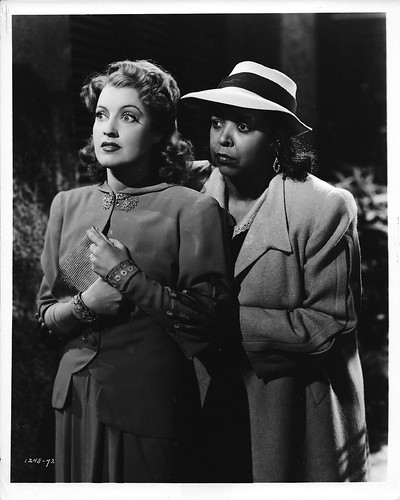 |
| Jeanette MacDonald & Ethel Waters 1942 MGM Film, CAIRO |
In the era of Jim Crow laws and early film and television, mainstream reaction to African Americans in roles of equality with whites was negative. The television and film industries tread lightly on racial ground, as not to offend the public by placing too much importance on the roles of blacks coming into American homes via television, a statement on popular culture.
Because filmmakers, producers, studios, distributors and theaters needed southern audiences for their product, some scenes were cut out of a film if the scene featuring a racially combined cast was judged to be too flattering or too respectful of black characters, especially black female characters, who were exclusive portrayed in movies as maids and nannies during the Jim Crow era. In the film CIARO, Ethel Waters took a non-threatening role behind her film co-star, Jeanette McDonald, a star among the Golden Girls of MGM with Lana Turner, Judy Garland, Grace Kelly (Late Princess Grace of Monaco) and Ava Gardener, among other female white stars, starts that made Hollywood History.
Race during the era of Jim Crow laws, was such a big deal that it extended beyond the screen of the movies. In early Hollywood when miscegenation laws were still on the books and in full effect, Hollywood studies forbade the romantic relationship of black and white actors on and off set.
White green-eyed actress Ava Gardener, reported to be bisexual, as taboo as interracial romance, nearly lost her MGM contract because she was dating Sammy Davis, Jr. Her studio demanded that the romance end immediately. Davis dated other white actresses, including Kim Novak, and in 1960 married Swedish actress, May Britt when interracial romance and marriage were still taboo nationwide, one of the reasons for Britt's retirement from movies. The couple raised three children together.
When Ethel Waters entered music and went from stage to studio, she was young, beautiful and vibrant, but was reduced to taking the subservient acting jobs Hollywood studios, television, radio and theaters allowed her and other black female actors to play--maids and servants with jobs in white households.
 |
Child of the Sixties Forever
Sammy Davis, May Britt
Children & Nanny
|
This was during the time when every aspect of American society was segregated--schools, employment, housing, marriage, facilities, recreation, entertainment, services and rights.
Black actors, who would take these acting jobs (some like Sammy Davis, Jr., part of the famed Rat Pack withe Frank Sinatra, Dean Martin, Joey Bishop and Peter Lawford would not) turned the roles into masterpieces that drew attention of mainstream audiences. However, acting jobs for black females, written to be subservient to roles played by white females, did not portray black women as feminine, sexy or in any way competitive with white lead actresses.
It is said that Waters took roles she did not respect because she needed the employment, but turned the cardboard stereotypical caricatures into human beings of substance. Stereotypical caricatures were the norm until the mid-1960s after Rosa Parks and Martin Luther King had burst onto the civil rights scene.

 |
| Georgette Harvey |
The 1939 Ethel Waters Show featured film and theater star Georgette Harvey and film star Freidi Washington
Georgette Harvey was born in 1884 in St. Louis, Missouri. She was a writer, singer and actress, famous for the role of Maria in the original 1935 George Gershwin Broadway production of the opera, Porgy and Bess.
Hattie McDaniel was the first African American actor to win an Academy Award for Best Supporting Actress for her 1939 role as the servant, Mammy, in the film, Gone with the Wind
 , starring Clark Gable, based on the novel, Gone With the Wind By Mitchell, Margaret, Hattie McDaniel, the first African American to sing on radio, singing with Will Rogers, famed actor and comic who made the 1934 film, Judge Priest, with McDaniel and African American actor, Stepin Fetchit. In this movie, McDaniel received her first on-screen acting credit, although she had made appearances in many other films for pay. In 1947, McDaniel created the CBS radio character, Beulah, for the 15-minute daily radio broadcast, The Beulah Show
 , a spin-off of the Fibber McGee and Molly radio program.
While her radio Beulah was on vacation in the summer of 1952, Hattie McDaniel filmed the first six episodes of the Beulah television production. Shortly thereafter, she suffered a heart attack, stroke and breast cancer. While ill, McDaniel recorded her Beulah radio show. She died on October 26, 1952 at the age of 57. McDaniel's television Beulah episodes would have made her the first black actor on American television instead of Ethel Waters had the shows been broadcast and not shelved by the television studio after her death. Some say the programs were never aired because McDaniel's contract demanded her script approval to prevent the degradation of her character. As a result of her editorial control, the programs were not suitable for racist Southern audiences.
In 1952, Ethel Waters was cast in the ABC TV sit-com, Beulah. Waters accepted the role of Beulah, which became the first regularly aired television program starring an African American. However, Beulah stirred such controversy, drawing criticism from the NAACP due to its degrading portrayal of African Americans, Ethel Waters left the show in protest. Louise Beavers took over the role and played the character as the studios demanded. In 1950, Waters took her talent to the Broadway stage, starring with Julie Harris in Member of the Wedding, and went on to the film version in 1952. Staying busy throughout her life, Waters wrote two books, both adapted for the stage. In 1957 and 1959, Waters was a guest on NBC's The Ford Show. This was one year after Rosa Parks and Martin Luther King had won the Supreme Court decision in the Montgomery Bus Boycott that started the dismantling of Jim Crow laws in America.
By the 1960s, after decades of being a star, Water's Hollywood career was over. The nation and African Americans had moved into a modern era that would not tolerate any reminders of Jim Crow. With the irreverent militant Black Power Movement pushing the peaceful patience of the Civil Rights Movement aside, Waters became a fading relic of the past. The final 20 years of her life, until her death, Ethel Waters spent touring with evangelist, Billy Graham.
Earlier this year, the Billy Graham Library hosted an exhibit of memorabilia, rare photographs and recordings: Ethel Waters: His Eye is on the Sparrow--also the title of one of Waters' autobiographies and a play adapted for stage. Ethel Waters died on September 2, 1977, in Chatsworth, California.
Freidi Washington, born in 1903 in Savannah, Georgia, is best known for her role in the film, Imitation of Life, playing the half-white daughter of Louise Beavers. With her green eyes and light complexion, Washington was ignored for acting jobs as maids in many movies. Because she was fair-skinned enough to pass for white, film producers feared she would be mistaken for white playing. Because Washington was not white, film producers would not cast her in their movies to play romantic leads opposite white actors such s Clark Gable, Cary Grant, Gary Cooper, Charles Boyer, Errol Flynn, William Powell or any other actor playing a love interest to a leading actress. In addition, during the era of Jim Crow laws, film producers were advised by movie distributors not to portray black actresses as glamorous.
 |
| Florence "Flo Jo" Griffith-Joyner |
It took television many decades to go from Jim Crow to the flashy star of the Olympics, Flo Jo, the fastest woman in the world.
The Olympics on television gave the world some of its first positive glimpses of American black women.
At the 1948 Summer Olympics in London, the world saw images of Alice Coachman when she became the first black woman to win an Olympic gold medal. In 1960, Wilma Rudolph, who had overcome polio, made national headlines on radio, television and newspapers when she became the first U.S. female to win three gold medals in track and field at the 1960 Rome Olympics.
Television cameras loved Florence Flo Jo Joyner's flash and speed at the 1988 Summer Olympics in Seoul, South Korea, where she became the world's fastest and most glamorous woman in track, setting records still unbroken and winning three gold medals. In the 1996 Summer Olympics in Atlanta, Dominique Dawes became the first African American female gymnast to win an Olympic gold medal, and remained the only one until the 2012 London Olympics, in which Gabby Douglas, became the first African American female gymnast to win the individual all-around gold medal.
 |
| Vanessa Williams First Black Miss America 1984 The Beauty of Miss America |
Ethel Waters made her television debut in 1939. Did she know the portal she opened? This included the first black Miss America, Vanessa Williams, in 1984.
The standards of American beauty changed forever and elevated black women to a new height of glamour when the television audience saw the diamond tiara being placed on the head of a black Miss America for the first time. Little black girls all over America looked as Vanessa Williams' achievement as validation of their own physicality. In addition, the mainstream world had to acknowledge that black woman on television and in films were more than servants to be offhandedly regarded no more than pieces of furniture. Like Ethel Waters, Vanessa Williams recorded popular music and became a film and television star.
 |
| Ethel Waters Recorded by Black Swan |
Being the first, Ethel Waters opened the door for African American women on television, in radio, movies, beauty and music. Waters led the way for other black women to become celebrated and decorated icons of theater, radio, television and movies.
Ethel Waters starred in the music, stage, television and film, earning awards in the Grammy Hall of Fame, National Recording Registry, Hollywood Walk of Fame, Christian Music Hall of Fame and Gospel Music Hall of Fame. Winner of an Emmy Award and a New York Drama Critics Circle Award, among others, Waters was a pioneer in the music recording industry, releasing phonograph records for Cardinal Records in 1919, Black Swan from 1921 to 1924 with the Jazz Masters and touring with Fletcher Henderson and the Black Swan Troubadours, and in 1925, signing a record deal with Columbia.
 |
| Ethel Waters & Jean Crain 1949 Hollywood Film, Pinky |
Known as the first black female superstar, Ethel Waters became one of the most popular and highest-paid stars of her day, rising from her humble childhood, daughter of a rape victim, mostly raising herself on the streets of Chester, Pennsylvania, until she married at age 13. She soon left the abusive husband, moved to Philadelphia and became a hotel maid until she was encouraged to sing a song. That song changed everything. At age 17, she began singing and dancing her way through the vaudeville circuits to Broadway to Hollywood and became the second African American to be nominated for an Academy Award for her 1949 performance as Dicey Johnson in the movie, Pinky .
.
Other stars in Waters' category at the 22nd Academy Awards were film actresses, Ethel Barrymore also for Pinky; Celeste Holm for Come to the Stable; and Elsa Lanchester also for Come to the Stable. The winner was film, radio and stage star, Mercedes McCambridge for All the King's Men, with Broderick Crawford, winner of Best Actor. McCambridge was nominated for Best Supporting Actress in 1956 for the film, Giant, starring Elizabeth Taylor, Rock Hudson and James Dean. Her filmography includes the 1973 film, The Exorcist, for which McCambridge dubbed the terrifying voice of the possessed child, played by Linda Blair.
.Before Ethel Waters, there was Hattie McDaniel, although they were contemporaries in movies and television.
 |
| Hattie McDaniel Receives Oscar from Fay Bainter, 1940 |
was the first African American actor to win an Academy Award for Best Supporting Actress for her 1939 role as the servant, Mammy, in the film, Gone with the Wind, starring Clark Gable, based on the novel, Gone With the Wind By Mitchell, Margaret, Hattie McDaniel, the first African American to sing on radio, singing with Will Rogers, famed actor and comic who made the 1934 film, Judge Priest, with McDaniel and African American actor, Stepin Fetchit. In this movie, McDaniel received her first on-screen acting credit, although she had made appearances in many other films for pay. In 1947, McDaniel created the CBS radio character, Beulah, for the 15-minute daily radio broadcast, The Beulah Show, a spin-off of the Fibber McGee and Molly radio program.While her radio Beulah was on vacation in the summer of 1952, Hattie McDaniel filmed the first six episodes of the Beulah television production. Shortly thereafter, she suffered a heart attack, stroke and breast cancer. While ill, McDaniel recorded her Beulah radio show. She died on October 26, 1952 at the age of 57. McDaniel's television Beulah episodes would have made her the first black actor on American television instead of Ethel Waters had the shows been broadcast and not shelved by the television studio after her death. Some say the programs were never aired because McDaniel's contract demanded her script approval to prevent the degradation of her character. As a result of her editorial control, the programs were not suitable for racist Southern audiences.
Ethel Waters continued to dazzle television audiences into her later years.
 |
| Ethel Waters & Tennessee Ernie Ford |
 |
| Billy Graham & Ethel Waters |
Earlier this year, the Billy Graham Library hosted an exhibit of memorabilia, rare photographs and recordings: Ethel Waters: His Eye is on the Sparrow--also the title of one of Waters' autobiographies and a play adapted for stage. Ethel Waters died on September 2, 1977, in Chatsworth, California.





 by Peter H. Irons. When I discovered this book, I was intrigued to find in one place the history of American education, traced along the color line. Irons surveys historical documents and court cases, and interviews participants in the desegregation and re-segregation of America's public schools.


 , which also offers
  .
.


