Translate


Showing posts with label radio. Show all posts

Monday, October 1, 2012

Jim Crow Laws & the Stage Mother

School, music and movies prepare for success.


Sunny Nash 8 Years Old
Sunny Nash
8 Years Old, from
Bigmama Didn't Shop
At Woolworth's

After my singing debut, my mother became my music director, companion, confidant, partner and co-conspirator when we were pursuing a dream of mine or hers, mostly hers.


There was no You Tube when I was eight years old in third grade at Booker T. Washington Elementary School. My music teacher, Eloise King, discovered that I could sing the old-fashioned way. I knew I could sing along with the radio but I never thought I was good enough to impress my music teacher. And I had no idea singing would be part of my education.

I saw her walking up and down the aisle during music class listening as the we sang lines from an arrangement she had chosen. On one of her strolls down the aisle, she stopped close to me and stood there for a few moments and then asked me to sing the song without the group. 


Back then, in addition to there being no You Tube, there were no American IdolThe Voice or America's Got Talent


I was afraid, thinking I was singing the song out of tune or something, which I didn't have to worry about singing with my radio. Then she asked if I would come to the auditorium at recess. I did. She told me she wanted me to sing a solo at the Spring Festival. That was the last recess for me throughout most of my remaining elementary school days. When other teachers saw me on that stage, they started making plans for me as well. If it wasn't Mrs. King rehearsing a new musical selection with me, it was Mr. Pruitt's gymnastics team or Mrs. Jackson preparing a dance routine that required new steps, elaborate makeup, which I was otherwise not allowed to wear, and vintage jewelry, which I was.

The next day, Mrs. King began teaching me the music to the Academy Award-winning song, Over the Rainbow, from the 1939 film, Wizard of Oz, instructing me to sing it exactly like the Judy Garland recording, which she sent home with me to practice before returning to school. I was already familiar with the music because I had seen the film numerous times when my mother took me to the movies whenever it encored at our Jim Crow movie theater in the 1950s or was rebroadcast on local television. Singing along with the music on the recording was different from my singing along with the radio. With the radio, I was just having fun. Singing with the recording was serious business. It would have been so much easier if You Tube had been around.

Sometimes, for television broadcasts of movies like Wizard of Oz and other shows, my mother made large bowls of popcorn to pass around our living room for the crowd of neighborhood kids and adults, who did not have television and, some of whom, had never been to the movies, a weekly trek for my mother and me. We saw all the latest movies that came to the Palace Theater downtown. My mother was as enthusiastic about movies as she was about school, books, radio, television and music, and we had plenty of books, and jazz and classical music in the house, and a revolving series of modern electronic technology on which to listen.


My mother insisted that I read books, see movies, hear music and travel for exposure to a larger world than the Jim Crow world where I lived. 


My mother insisted that I dress a certain way and she strained our budget to make sure I had the appropriate wardrobe and shoes for a teenage girl in the 1960s. My cousins looked at me with envy. They thought I was pretentious, but it wasn't me. My mother dressed me. "Everything you do reveals who you are and who you want to be," she said. All of this my mother did to produce the person she wanted me to become. What she counted on was my cooperation in her plan. Doing well in school was the most important part of her plan. It all paid off when I won a beauty and talent competition and became a statewide celebrity.

We traveled on buses, trains and, when I was older, airplanes to our destinations. 


My mother took me to museums, galleries, beaches, mountain resorts, amusement parks, tourist sites, restaurants and sporting events. This was all part of my education. We left the state to visit these attractions. Jim Crow kept us out of them at home. She encouraged me to learn new games and keep up with current events that I was required to read about in our tiny home library.

I practiced the music to Over the Rainbow with the recording Mrs. King loaned me. Again and again, I tried my best to sing the song like Judy Garland. After studying the lyrics and melody and trying to stay true to the Judy Garland version, I gained a lot of confidence in my abilities. This confidence would extent to more places than on stage and my mother seemed to see something in me that she had not seen before the performance. I caught her watching as I sang along with the music and hoped she would not get the idea to find a Dorothy costume for my performance. The original Dorothy dress is now up for auction and estimated to bring between $400,000 and $600,000. Even so, back then, as much as I loved the song, I did not want to wear Dorothy's homely dress. I might as well show up at the school festival to perform the music wearing a Cowardly Lion mask to complete the outfit.I cannot imagine how many hits I would have gotten on You Tube wearing that mask.

For the night of my performance,
fortunately, my mother and Mrs. King agreed that I should wear a dainty pink dress that I already owned. I stepped upon a stack of soda pop crates in front of the microphone. I was very small for my age and needed a boost. I had practiced with the microphone and amplifier several times before the performance and felt very comfortable with the electronic equipment, as if I were a real entertainer in the music business, a recording artist in a recording studio or on the radio.

Standing up there on the stage in front of the audience, I was not nervous as a full house stared at me. Mrs. King played the introductory music to the song on piano and gave me the nod. I took a deep breath silently through my nose as she had instructed and sang the song the way we had rehearsed, paying close attention to microphone technique. When I hit my high strong notes, I held my face away from the microphone to control the amount of sound going into the microphone. 

Mrs. King had told me at rehearsal, "Back off! You're going to blow out their ears!" My own ears rang with feedback, produced by a voice untrained in mic performing. By the time that rehearsal was finished, I knew how to handle my voice using a mic. Of course, stage electronics back then were nothing compared to the ear buds and mini mics modern entertainers strut around with on stage today, to mention sophisticated HD video instantly available for instant upload to YouTube

I sang Over the Rainbow as if the song belonged to me, instead of Judy Garland. And I knew I had nailed it as I hung onto the last note of the song before I got a standing ovation from my neighborhood friends, classmates and teachers at school. That night prepared me for many things to come in my life, including hearing my own song on the radio one day.

Mrs. King was so pleased with my performance, she gave me the Judy Garland recording as a gift. My mother, more pleased and surprised than Mrs. King, had no idea I could sing until she heard me practicing, but she was quiet about it until the performance was over. I have Mrs. King and the Judy Garland recording of the song, Over the Rainbow, in the film, Wizard of Oz, to thank for giving me the confidence that helped to shape my life.

All of my singing and seeming joy with it stunned and pleased my mother because she couldn't get me to sing a Christmas song around the tree with her. She didn't realize I had been embarrassed to sing in front of her. She had such a wonderful voice and I felt my voice was inferior to hers. Feeling that her own time for singing professionally had past, I believe it was on the night of my song, Over the Rainbow, that my mother got ideas about entering me in The Ted Mack Amateur Hour and other competitions.

Nearly a quarter century ago, Judy Garland sang the song originally. More than a half century ago, Mrs. King picked the classic for my first song on our little school stage. In 2000, the Recording Industry Association of America and the National Endowment for the Arts voted Over the Rainbow as the #1 song of the 20th Century. When I read the announcement, memories flooded back to me of my childhood. 

Popularized by the film, Wizard of Oz, produced before I was born, Over the Rainbow had been part of my life throughout my life and had a great deal to do with my education, confidence and career choices. The song Mrs. King taught me helped to bring me to the place my mother worked so hard to get me, in spit of Jim Crow Laws. 

Bigmama Didn't Shop At Woolworth's by Sunny Nash
Bigmama Didn't Shop
At Woolworth's
by Sunny Nash

In the 1990s, I began writing a newspaper column based on my life during the era of Jim Crow laws.


My mother encouraged me to change the focus to family topics, involving the experiences her mother, my part-Comanche grandmother, Bigmama. These topics still involved Jim Crow laws, but did not center on the subject of discrimination. "People have heard enough about segregation and they're tired of it," she said. "Aren't You? I know I am. Write about your family and let their lives tell the story of civil rights. That way people won't blame you for preaching to them."

My mother's tactic worked. People loved hearing stories of our lives, even when mixed with a little non-preachy racial politics of the day. Then she advised me to use the local column to build my reputation as a writer. She was right again. The local column led to a regional column, then a syndicated column and eventually gave birth to my first book, Bigmama Didn't Shop At Woolworth's (Texas A&M University Press).

My mother was delighted when this book came out. The idea that I had written about her mother and other ancestors pleased her. After one book signing, we were sitting at the kitchen table in the house where I grew up. "You're doing better than the drug dealers in the neighborhood," she said. Although, she was just guessing how much money the neighborhood drug dealers made. There were no drug dealers in the neighborhood when I was growing up and my mother was teaching me how to have good posture at the same time that she was teaching me to use power tools. Time passes. Things change.

Thank you, Littie Nash, for being my mother and taking the job so seriously. I wouldn't be who I am without you.

Sunny Nash Author of Bigmama Didn't Shop At Woolworth's
Sunny Nash
Bigmama Didn't
Shop At
Woolworth's
Sunny Nash has also co-authored, edited or compiled several books, written three newspaper columns, created a major photographic study and exhibition, produced and written for television, and conducted public speaking tours. “Fortunately, writing comes easy to me and I am able to produce all kinds of copy and media—movie treatments, television scripts, book manuscripts, proposals, commercial jingles, whatever a client needs,” Nash said. “I also produce video for broadcast and Internet marketing and distribution. My client list includes corporations, cities, chambers of commerce, nonprofit organizations, real estate companies and all kinds of groups and individuals, The balance for any artist is making sure their own work does not suffer, while giving the client the best work possible.”


Bookmark and Share Sunny Nash

Sunny Nash on My Zimbio


© 2012  Sunny Nash
All Rights Reserved Worldwide.

~ Thank You~

Monday, August 6, 2012

Jim Crow Laws, Ethel Waters and Television

Ethel Waters, first African American Star on television
Ethel Waters
First African American Star
on American Television

The Ethel Waters Show
June 14, 1939

Ethel Waters was the first black television star.


Ethel Waters was the star of The Ethel Waters Show, which debuted in 1939 during the height of Jim Crow laws in America, long before Rosa Parks, Martin Luther King and the modern civil rights movement.

Ethel Waters entered music, radio, television, movies and stage, became a Hollywood star of race movies. Radio, television and film producers, band leaders, song writers and music industry career executives took notice of Waters as she developed the ability to master a song in music genres of blues and jazz. 

Ethel Waters' life (1896-1977) spanned an entire music, radio, television, film and Jim Crow era.


In 1896, the year of her birth, the Supreme Court ruled in Plessy v Ferguson to uphold segregation in America, opening the door to discrimination and degradation in all aspects of African American life, including aspects of African American life that had not yet been invented, such as radio, television, movies and music recording. The Plessy decision stayed in force until Rosa Parks and Martin Luther King got it wiped off the books after the Montgomery Bus Boycott.

Ethel Waters was the first African American star in a sponsored and syndicated coast-to-coast radio show.


Ethel Waters on NBC Radio
Ethel Waters on Radio
In 1933, Ethel Waters was the singer for white band leader, Jimmy Dorsey. 

Remembered as a matronly servant to white families in radio, movies and television, Ethel Waters was a radio star before she put on an apron. Because of her radio and vaudeville circuit experience, Ethel Waters was sought for theater roles, Mamba's Daughters, Cabin in the Sky and Member of the Wedding. Later, she appeared in the film versions of Cabin in the Sky and Member of the Wedding, and appeared in the Hollywood film features, Gift of Gab, Cairo, Tales of Manhattan, Pinky and The Sound and the Fury.

Ethel Waters' 1939 television special contained an excerpt of her 1939 theater production, Mamba's Daughters. Like the book, Mamba's Daughtersthe stage play was about a maid, typical for the Jim Crow era. At that time maids, nannies and servants were the reality of an African American woman's life and a reality that black Hollywood accommodated with stereotypical roles in movies. Because early television and movies, like their modern counterparts, relied on sponsors and viewers for financing, filmmakers were careful not to offend audiences, especially in the American Deep South, where segregation was particularly strong. 


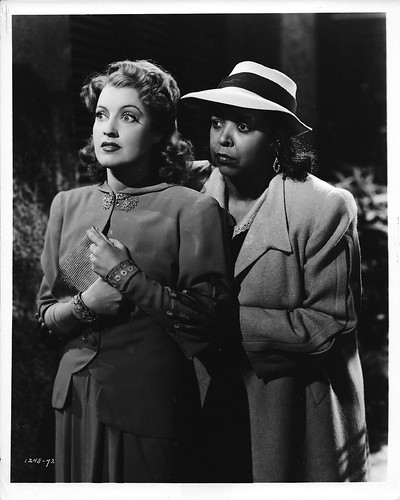
eanette MacDonald  & Ethel Waters  1942 MGM Film, CAIRO
Jeanette MacDonald 
& Ethel Waters 
1942 MGM Film, CAIRO
In the era of Jim Crow laws and early film and television, mainstream reaction to African Americans in roles of equality with whites was negative. The television and film industries tread lightly on racial ground, as not to offend the public by placing too much importance on the roles of blacks coming into American homes via television, a statement on popular culture


Because filmmakers,  producers, studios, distributors and theaters needed southern audiences for their product, some scenes were cut out of a film if the scene featuring a racially combined cast was judged to be too flattering or too respectful of black characters, especially black female characters, who were exclusive portrayed in movies as maids and nannies during the Jim Crow era. In the film CIARO, Ethel Waters took a non-threatening role behind her film co-star, Jeanette McDonald, a star among the Golden Girls of MGM with Lana Turner, Judy Garland,  Grace Kelly (Late Princess Grace of Monaco)  and Ava Gardener, among other female white stars, starts that made Hollywood History


Race during the era of Jim Crow laws, was such a big deal that it extended beyond the screen of the movies. In early Hollywood when miscegenation laws were still on the books and in full effect, Hollywood studies forbade the romantic relationship of black and white actors on and off set. 


Child of the Sixties Forever Sammy Davis, May Britt Children & Nanny
Child of the Sixties Forever
Sammy Davis, May Britt
Children & Nanny
White green-eyed actress Ava Gardenerreported to be bisexual, as taboo as interracial romance, nearly lost her MGM contract because she was dating Sammy Davis, Jr. Her studio demanded that the romance end immediately. Davis dated other white actresses, including Kim Novak, and in 1960 married Swedish actress, May Britt when interracial romance and marriage were still taboo nationwide, one of the reasons for Britt's retirement from movies. The couple raised three children together.

This was during the time when every aspect of American society was segregated--schools, employment, housing, marriage, facilities, recreation, entertainment, services and rights. 

When Ethel Waters entered music and went from stage to studio, she was young, beautiful and vibrant, but was reduced to taking the subservient acting jobs Hollywood studios, television, radio and theaters allowed her and other black female actors to play--maids and servants with jobs in white households. 

Black actors, who would take these acting jobs (some like Sammy Davis, Jr., part of the famed Rat Pack withe Frank Sinatra, Dean Martin, Joey Bishop and Peter Lawford would not) turned the roles into masterpieces that drew attention of mainstream audiences. However, acting jobs for black females, written to be subservient to roles played by white females, did not portray black women as feminine, sexy or in any way competitive with white lead actresses

It is said that Waters took roles she did not respect because she needed the employment, but turned the cardboard stereotypical caricatures into human beings of substance. Stereotypical caricatures were the norm until the mid-1960s after Rosa Parks and Martin Luther King had burst onto the civil rights scene.

Google
Georgette Harvey
Georgette Harvey

The 1939  Ethel Waters Show featured film and theater star Georgette Harvey and film star Freidi Washington 


Georgette Harvey was born in 1884 in St. Louis, Missouri. She was a writer, singer and actress, famous for the role of Maria in the original 1935 George Gershwin Broadway production of the opera, Porgy and Bess


Freidi Washington, born in 1903 in Savannah, Georgia, is best known for her role in the film, Imitation of Life, playing the half-white daughter of Louise Beavers. With her green eyes and light complexion, Washington was ignored for acting jobs as maids in many movies. Because she was fair-skinned enough to pass for white, film producers feared she would be mistaken for white playing. Because Washington was not white, film producers would not cast her in their movies to play romantic leads opposite white actors such s Clark Gable, Cary Grant, Gary Cooper, Charles Boyer, Errol Flynn, William Powell or any other actor playing a love interest to a leading actress. In addition, during the era of Jim Crow lawsfilm producers were advised by movie distributors not to portray black actresses as glamorous.

Florence "Flo Jo" Griffith-Joyner

It took television many decades to go from Jim Crow to the flashy star of the Olympics, Flo Jo, the fastest woman in the world.


The Olympics on television gave the world some of its first positive glimpses of American black women.


At the 1948 Summer Olympics in London, the world saw images of Alice Coachman when she became the first black woman to win an Olympic gold medal. In 1960, Wilma Rudolph, who had overcome polio, made national headlines on radio, television and newspapers when she became the first U.S. female to win three gold medals in track and field at the 1960 Rome Olympics.

Television cameras loved Florence Flo Jo Joyner's flash and speed at the 1988 Summer Olympics in Seoul, South Korea, where she became the world's fastest and most glamorous woman in track, setting records still unbroken and winning three gold medals. In the 1996 Summer Olympics in Atlanta, Dominique Dawes became the first African American female gymnast to win an Olympic gold medal, and remained the only one until the 2012 London Olympics, in which Gabby Douglas, became the first African American female gymnast to win the individual all-around gold medal.

Vanessa Williams First Black Miss America 1984
Vanessa Williams
First Black Miss America 1984

The Beauty of Miss America

Ethel Waters made her television debut in 1939. Did she know the portal she opened? This included the first black Miss America, Vanessa Williams, in 1984. 


The standards of American beauty changed forever and elevated black women to a new height of glamour when the television audience saw the diamond tiara being placed on the head of a black Miss America for the first time. Little black girls all over America looked as Vanessa Williams' achievement as validation of their own physicality. In addition, the mainstream world had to acknowledge that black woman on television and in films were more than servants to be offhandedly regarded no more than pieces of furniture. Like Ethel Waters, Vanessa Williams recorded popular music and became a film and television star.


Black Swan Recording by Ethel Waters
Ethel Waters
Recorded by Black Swan 
Being the first, Ethel Waters opened the door for African American women on television, in radio, movies, beauty and music. Waters led the way for other black women to become celebrated and decorated icons of theater, radio, television and movies. 

Ethel Waters starred in the music, stage, television and film, earning awards in the Grammy Hall of Fame, National Recording Registry, Hollywood Walk of Fame, Christian Music Hall of Fame and Gospel Music Hall of Fame. Winner of an Emmy Award and a New York Drama Critics Circle Award, among others, Waters was a pioneer in the music recording industry, releasing phonograph records for Cardinal Records in 1919, Black Swan from 1921 to 1924 with the Jazz Masters and touring with Fletcher Henderson and the Black Swan Troubadours, and in 1925, signing a record deal with Columbia.

Ethel Waters, Pinky
Ethel Waters & Jean Crain
1949 Hollywood Film, Pinky
Known as the first black female superstar, Ethel Waters became one of the most popular and highest-paid stars of her day, rising from her humble childhood, daughter of a rape victim, mostly raising herself on the streets of Chester, Pennsylvania, until she married at age 13. She soon left the abusive husband, moved to Philadelphia and became a hotel maid until she was encouraged to sing a song. That song changed everything. At age 17, she began singing and dancing her way through the vaudeville circuits to Broadway to Hollywood and became the second African American to be nominated for an Academy Award for her 1949 performance as Dicey Johnson in the movie, Pinky.

Other stars in Waters' category at the 22nd Academy Awards were film actresses, Ethel Barrymore also for  Pinky; Celeste Holm for Come to the Stable; and Elsa Lanchester also for Come to the Stable. The winner was film, radio and stage star, Mercedes McCambridge for All the King's Men, with Broderick Crawford, winner of Best Actor. McCambridge was nominated for Best Supporting Actress in 1956 for the film, Giant, starring Elizabeth Taylor, Rock Hudson and James Dean. Her filmography includes the 1973 film, The Exorcist, for which McCambridge dubbed the terrifying voice of the possessed child, played by Linda Blair.


Before Ethel Waters, there was Hattie McDaniel, although they were contemporaries in movies and television.


Hattie McDaniel Receives Oscar from Fay Bainter, 1940
Hattie McDaniel Receives Oscar
from Fay Bainter, 1940


Hattie McDaniel was the first African American actor to win an Academy Award for Best Supporting Actress for her 1939 role as the servant, Mammy, in the film, Gone with the Wind, starring Clark Gable, based on the novel, Gone With the Wind By Mitchell, Margaret, Hattie McDaniel, the first African American to sing on radio, singing with Will Rogers, famed actor and comic who made the 1934 film, Judge Priest, with McDaniel and African American actor, Stepin Fetchit. In this movie, McDaniel received her first on-screen acting credit, although she had made appearances in many other films for pay. In 1947, McDaniel created the CBS radio character, Beulah, for the 15-minute daily radio broadcast, The Beulah Showspin-off of the Fibber McGee and Molly radio program.

While her radio Beulah was on vacation in the summer of 1952, Hattie McDaniel filmed the first six episodes of the Beulah television production. Shortly thereafter, she suffered a heart attack, stroke and breast cancer. While ill, McDaniel recorded her Beulah radio show. She died on October 26, 1952 at the age of 57. McDaniel's television Beulah episodes would have made her the first black actor on American television instead of Ethel Waters had the shows been broadcast and not shelved by the television studio after her death. Some say the programs were never aired because McDaniel's contract demanded her script approval to prevent the degradation of her character. As a result of her editorial control, the programs were not suitable for racist Southern audiences.


Ethel Waters continued to dazzle television audiences into her later years.


Ethel Waters  & Tennessee Ernie Ford
Ethel Waters 
& Tennessee Ernie Ford
In 1952, Ethel Waters was cast in the ABC TV sit-com, Beulah. Waters accepted the role of Beulah, which became the first regularly aired television program starring an African American. However, Beulah stirred such controversy, drawing criticism from the NAACP due to its degrading portrayal of African Americans, Ethel Waters left the show in protest. Louise Beavers took over the role and played the character as the studios demanded. In 1950, Waters took her talent to the Broadway stage, starring with Julie Harris in Member of the Wedding, and went on to the film version in 1952. Staying busy throughout her life, Waters wrote two books, both adapted for the stage. In 1957 and 1959, Waters was a guest on NBC's The Ford Show. This was one year after Rosa Parks and Martin Luther King had won the Supreme Court decision in the Montgomery Bus Boycott that started the dismantling of Jim Crow laws in America.

Evangelist Billy Graham & Ethel Waters
Billy Graham & Ethel Waters
By the 1960s, after decades of being a star, Water's Hollywood career was over. The nation and African Americans had moved into a modern era that would not tolerate any reminders of Jim Crow. With the irreverent militant Black Power Movement pushing the peaceful patience of the Civil Rights Movement aside, Waters became a fading relic of the past. The final 20 years of her life, until her death, Ethel Waters spent touring with evangelist, Billy Graham.

Earlier this year, the Billy Graham Library hosted an exhibit of memorabilia, rare photographs and recordings: Ethel Waters: His Eye is on the Sparrow--also the title of one of Waters' autobiographies and a play adapted for stage. Ethel Waters died on September 2, 1977, in Chatsworth, California. 


© 2012 Sunny Nash. All Rights Reserved Worldwide.
~Thank You~


Bookmark and Share

Monday, June 11, 2012

What's Blues Got To Do With IT?

Sunny Nash--author, journalist and former Brunswick recording artist--took the downtown Palace Amphitheatre Stage at the first Bryan Texas Blues Festival.


I didn't know if I still had IT! You know what IT is? That stuff that makes you good at something. I guess I do still have IT!  Because a lot of people seemed to enjoy my IT on stage at the Bryan Texas Blues Festival. The important thing is that people enjoyed my performance and I enjoyed performing the music. Many old musician friends and fans came out. In fact, two of the best bass players in the country--Rick Moses and Brian Lippman--both of whom I have had the privilege of making music, came backstage after my performances, and so many others. It was great seeing everyone again. I thank each and everyone of you for your support back in the day and to this new day.

Let's do it again next year. But just for fun like this time. The music industry was good to me but at this point in my life I have nothing more to prove on that front. Writing books is my IT these days. Search in the box below to find my Web Sites, Blogs and other literary areas. In fact, I hope you will join this Blog to get my updates, or subscribe to my feeds on face book. Thanks for your devotion and loyalty over the past years and in the future. 

Hats off to the City of Bryan, Texas!
Sunny Nash
Sunny Nash, Jeff Zwolinski
Sunny Nash
Jeff Zwolinski, Drummer
Bryan Texas Blues Festival
Sunny Nash began her music career learning to play the blues and other forms of music when she met Houston’s KYOK radio celebrity and media personality, George Nelson, who presented her a scholarship for winning the Miss Texas High Contest in 1965; she was a sophomore in high school. For the talent portion of the competition, she sang a medley of the 1964 R&B Motown hit, Every Little Bit Hurts, by Brenda Holloway; and the jazz standard, Misty, written by pianist, Erroll Garner in 1954.

After winning the contest, I sang those songs on television shows and was interviewed on radio.


"I learned to sing all kinds of music--blues, R&B, gospel, pop, country and classical--from listening to records and the radio," Nash said. "Then later, I took piano lessons and learned to read sheet music, and started playing piano by ear." Nash listened to Dinah Washington, Sarah Vaughn, Nancy Wilson and Frank Sinatra to learn to sing jazz and blues

"It was all about phrasing and timing," Nash said. "How to group the words of the song, emphasis and finesse. I learned that singers do not have to sing every note they know to perform the song well. In fact, singing too many notes sounds like you are just showing off everything you know and not really making the point of the song."

During the summer of 1966, George Nelson booked Nash to sing jazz and blues songs live on KYOK broadcasts with the Conrad Johnson Orchestra at the El Dorado Ballroom on Elgin Street in Houston’s Third Ward. Although she was only 16, her jazz and blues performances were reviewed in newspapers as mature and moving. Nash also performed at Ray Barnett's Cinder Club with John Roberts and the Hurricanes, getting the attention of Don Robey at Duke-Peacock Records. "George told my mother not to sign me up with Robey because that bunch was too rough for a little girl or a grown woman or man!"

Nash also hung out at radio stations a lot, learning from DJs how to spin records and talk trash, she said. While performing in Houston, Nash shared stages with blued-eyed soul singer, Roy Head, and R&B teen group, Archie Bell & the Drells, discovered by Skipper Lee Fraiser, legendary Houston DJ at KCOH, the first black radio station in Texas. "George and Skipper Lee were both very protective of the young acts in their charge."

In 1967, KTSA radio celebrity, Ricci Ware, saw Nash in a talent show he was hosting in Bryan. 

"I had borrowed Washington School Principal Oliver Sadberry's reel-to-reel tape recorder and laid the track that I sang to in the talent show," Nash said. "I didn't really know what I was doing. But I knew what I wanted the music to sound like; and my best friend and Miss Texas High Contest accompanist, Raymond Buchanan, two years older than me, was gone off to fight in Vietnam. So I played Moon River over and over into Mr. Sadberry's little reel-to-reel tape recorder until I had what I wanted as my accompaniment. It wasn't as good as Raymond would have played it, but it sounded pretty good. When the judge announced me, he made a big deal of my music track and treated it as part of my talent act. Ricci Ware thought it was pretty good, too, and arranged an audition at Abe Epstein Enterprises in San Antonio to work as a studio musician, background vocalist and label recording artist after I graduated later that Spring."

Repetition of the same music passages over and over again was the key to getting it to sound the way I wanted it.


In 1968, Epstein released Nash's country blues recording, I Am Nothing Without You, written by Ricky "Güero Polkas" Davila, then a songwriter for Epstein Studios and also a DJ at San Antonio's Radio Jalapeno, KEDA 1540 AM, the nation's only conjunto radio station, which Davila's family has owned since 1966, important players in the music industry in San Antonio. Playing a mix of rock, soul, conjunto, Tejano, R&B and oldies, Davila became the legendary KEDA voice 44 years ago, shortly after which, the song he wrote for Nash created for the young singer a Gulf Coast sensation from Texas to Florida, where she sang a mix of blues, country and Tejano music.

Abe Epstein
Nash's ability to use her speaking voice on microphone, play piano, overdub her own singing voice using recording equipment and her general interest in the recording business increased her value to the studio. From Epstein, Nash learned the technology of the era in music and audio production, and sound engineering. 

"At the studio, I also helped write, voice-over and produce radio commercials for local stations," Nash said. "Abe had a 4-track studio. Four-track recording may sound simple when compared to infinite digital track recording today, but recording complex mixtures of music was very complicated at that time. Mostly every session had to be perfect. And there was little or no overdubbing in the recording industry at the time. This was during a time when track recording on analog tape was still in its infancy."

From Epstein, Nash also began learning the sound recording business, setting up amplifiers, microphones, mixers and speakers at performances. "I strung wire with the guys in the band and picked up most anything that wasn't heavier than me, which was most everything," Nash said. "I wanted to learn everything about the music business and I did. I can set up mics, mixers, amps, lights, screens, projectors, cameras and all kinds of event and staging equipment. I even built my own video studio with sound. I like doing that kind of thing, knowing one kind of plug from another. And now, with the Internet, I'm having a blast!"

When Nash's contract with Epstein ended, she returned to Houston, where she worked as a studio musician and technician, formed a band, played local nightclubs and appeared often on the television show, Dialing for Dollars, with pianist, Paul Schmidt, who had pioneered early television in Houston. “I was fortunate to have a chance to work on television with Paul Schmidt,” Nash said. “It wasn't often that black artists got chances like that in 1971. And Paul, who was not opposed to working with young black artists, was one of the best pianists in the country, having played and recorded with Arnett Cobb, Pearl Bailey. Jimmy Dorsey, Frank Sinatra and most anybody else who was anybody in the music business. One of the most important things I learned from Paul was to leave ego at the door. He wasn't interested in working with Divas or anyone else who thought they were too gifted and precious to work hard.”


The Third Movement by Sunni Nash
In Houston, Nash arranged music for other performers, laid original music tracks for those who could not play an instrument and began writing songs of her own. In 1971, Nash went to New York and auditioned for Brunswick Records. They signed Nash to a contract as a studio musician and songwriter. With Curtis Mayfield’s Super Fly soundtrack trio, headed by drummer, Quinten Joseph, Nash co-wrote and recorded The Third Movement and released it on BRC, reserving its Brunswick brand for stars like Jackie Wilson, the Chi-Lites, Barbara Aklin, Tyrone Davis, Laverne Baker and other proven money makers.  Well, The Third Movement now has a new generation of worldwide Internet cult followers of old-school, deep funk. Who would have guessed?

After a successful career in music, Nash decided she'd had enough. "I was tired of living on the road out of suitcases or sitting around studios all day waiting for a session to start, although the money was really good," Nash said. "When you are changing the course of your life and career, you have to be careful not to waste time. You have to know what to do before it's too late to act or you lose your enthusiasm for something like going to school. I wanted a real life and a solid profession that I would not mind my child following, the same example of great mothering my own mother had set for me."

Using her voice, love for radio, production skills and knowledge of electronics from her old recording studio days and music-making nights on the stage, Nash became the area’s first black radio professional for mainstream audiences in her groundbreaking position as radio news reporter on WTAW Country in 1974. "Bill Watkins heard some commercials I'd recorded for Radio Shack and said, 'I want that voice on this station! Who is that!' When he found out who I was, he called and offered me a job. He didn't know or care that I was black. When we did meet, Bill did not take a second glance at me when he pushed a tape recorder into my hands and told me what time the College Station City Council met later that day," Nash said. "I learned a lot from Bill and the job helped me pay for school, get some real news credentials and get very connected in the community."


While attending Texas A&M, Nash performed on stage in Houston and locally to supplement her income, and she wrote and recorded commercials for local radio productions and political campaigns. As time passed, the local television market began opening up to African American talent and Nash became the first black spokes-model in Bryan for Star Tel Communications. "I had a commercial that ran during Super Bowl back in the 1970s," Nash said.

In 1977, Nash became one of the first African American women to graduate from Texas A&M University, and the first African American to earn a degree in journalism and broadcasting from the University. "I was among the first dozen black women to graduate from Texas A&M University," Nash said. "The first one that I know of was in 1970, the same year as the first Hispanic female graduate. Women of color have been at A&M since the day the doors were opened to us."

With her brand new journalism degree, Nash took her second groundbreaking position, Program Director at National Public Radio (NPR)-affiliated KAMU-FM. "While at KAMU-FM, I helped develop the classical format and produced a number of news items for the NPR program, All Things Considered. I also reported the weather one summer for our sister station, KAMU-TV, until they hired weatherman, Bob Rose. Until he came on board, I was the only person on staff who had taken a course in meteorology and physical geography. I knew the states by shape, a requirement because newsroom weather maps have no labels. Then I figured out how to translate National Oceanic Atmospheric Administration (NOAA) dot-matrix printouts to the weather map in the newsroom. I cheated a little by checking the weather maps on other channels to make sure I was close. This was eons before the National Weather Service had Doppler. I was really glad when Bob took over."

Nash said her love for writing was not enough. "I needed to learn how to make a living writing," she said. "It was a lot different from the music industry, although, it takes the same discipline to be a successful writer or successful musician. Discipline and developing good habits are keys to any success in life, as far as I am concerned. And do not wait for a visit from the muse for your inspiration. Sit down every day in front of your keyboard and play or write. That's all the inspiration you will ever need."

I Can See Clearly Now
In 1978, Nash went to the British Isles with Johnny Nash’s I Can See Clearly Now tour as a vocalist, keyboardist, percussionist and dancer, working with Marvin Gaye’s music director and songwriting partner, Odell Brown. "I was not trying to resurrect my music career," Nash said. "I went as a favor to Johnny. His regular stage candy was not available."


During the 1980s, Nash wrote for magazines and newspapers, became a photographer and producer, and learned graphic design. In 1990, Nash wrote, produced and scored a University of Texas film, We Have Something To Say, nominated for a Robert F. Kennedy Journalism Award and placed in the John F. Kennedy Library. The theme song that resulted from the film won Nash a People’s Sammy Davis Nomination for Songwriting.


We Have Something to Say
A Film by Sunny Nash 
University of Texas Health Science Center UTTV
How Children with Physical and Mental Challenges Overcome Learning Difficulties
__________________________________________________________


Blues Festival
“People often ask me if I still sing," Nash said. "What a loaded question. Are they asking if I can still sing? Are they asking do I still sing professionally? I tell them, yes, I still sing. I came into the world singing. I sang before I wrote one word or took one picture or produced one video. My heart sings even when my lips are not moving. My heart has its own tunes, tunes that keep me wanting to move, wanting to live. I don't make a living at music anymore, but, yes, I still sing. Music keeps me living."

Nash was followed by William Walker, Damu Sudi Alii, Donald Ray Johnson and Nat Dove. Eugene Eugene & the Solid Foundation Band, will accompany the performers.

Bigmama Didn't Shop At Woolworth's by Sunny Nash
Bigmama Didn't Shop
At Woolworth's

by Sunny Nash
The African American
National Biography

Harvard & Oxford
Sunny Nash became a nationally syndicated newspaper columnist for Hearst, Knight-Ridder and Black Conscious; music historian and critic with jazz and blues profiles in the  The African American National Biography: Eight-volume set  (Harvard and Oxford 2008); and a world-renown photographer with images in the Smithsonian Institution in Washington DC, Schomburg Center for Research in Black Culture in New York and the Houston Public Library.

Sunny Nash is author of Bigmama Didn’t Shop At Woolworth’s (Texas A&M University Press), about life with her part-Comanche grandmother before and during the Civil Rights Movement. Nash’s book is recognized by the Association of American University Presses for contributions to understanding U.S. race relations; listed in the Bibliographic Guide to Black Studies by the Schomburg Center for Research in Black Culture in New York; and recommended for Native American Collections by the Miami-Dade Public Library System in Florida.


© 2012 Sunny Nash. All Rights Reserved Worldwide.

Bookmark and Share