Translate


Wednesday, April 3, 2013

Woolworth Sit-ins & Jim Crow Laws

Rosa Parks, Martin Luther King and other sit-ins and demonstrations destroyed Jim Crow laws and changed civil rights.


Alexandria Library 
Sit-in & Arrest
Even libraries were 
segregated. Those 
participating in sit-ins 
were punished  and jailed.


George Zimmerman Family
Photo: CNN
Grandmother
Great Grandfather
Mother, the infant

Those historic civil rights actions are being remembered as protesters demonstrate against the George Zimmerman verdict.


How do the more recent demonstrations against Trayvon Martin's death in the Zimmerman case differ from historic civil rights marches? One difference is that historic protests were aimed at crushing Jim Crow laws, a specific set of statues written especially to discriminate against former slaves after the Civil War. These laws were supported, in part, by organized racist groups that were formed to enforce Jim Crow laws, outside the real law. On the contrary, protests of the George Zimmerman verdict in the shooting death of Trayvon Martin are not aimed specifically at any group of persons organized to destroy freedom of people of color or interfere with their ability to get an education. Right?

Some say that the system is structured against people of color and interferes with their education and their freedom. The question that arises in the Zimmerman case is: Who are the people of color? Certainly Trayvon Martin is a person of color. But what about George Zimmerman, whose great grandfather is said to be a black man? Wouldn't that make George Zimmerman a black man? The one drop rule would certainly apply here. Historically, if it can be shown by a person's appearance or demonstrated in a person's bloodline that African heritage is present, then the person is classified as black. If George Zimmerman is technically a black man, how can the death of Trayvon Martin be a white-on-black offense and not black-on-black? I'm simply asking questions. Please, provide your own answers.

The Woolworth Sit-ins starting in 1960 were not the only sit-ins or the first protests of Jim Crow laws. Throughout the  history of slavery in the United States, people demonstrated against violent treatment. After emancipation, people demonstrated against violent treatment and inferior access to services and facilities. One hundred years later, people were demonstrating to be allowed to vote.

This article is intended to look back at little known protests and figures leading up to the modern Civil Rights Movement, which some say stated officially when Rosa Parks ignited the Montgomery Bus Boycott and launch Martin Luther King as the leader of the movement.


In 1939, African-American civil rights attorney Samuel Wilbert Tucker, organizer of a sit-in to desegregate the Alexandria, Virginia library. Tucker, was born 100 years ago on June 18, 1913, the same year as Rosa Parks


Tucker, born in Alexandria, Virginia, rose to the rank of Major in the United States Army during World War II, spent most of life, since age 14 when he refused to give up his seat on a streetcar to a white passenger, fighting Jim Crow laws and leading the cause for civil rights.

Virginia public library case was an early example of the non-violent Civil Rights Movement, led by Martin Luther King, that would spread across the nation through the 1960s. These protests were intended to give the word public it true meaning that included African Americans and other people of color in the access to public facilities and services, and equal education, to prepare them for a college education.

That same year, 1939, Marian Anderson's attempt to defy Jim Crow laws launched her as the voice of civil rights. 


Marian Anderson was not just an important American singer, she was a U.S. civil rights leader in her own right. Choosing to sing opera and recital music, Anderson brought classical music to the African American community as well as to the world. Much of her career was centered in Europe because of Jim Crow laws in the United States.

First Lady Eleanor Roosevelt & Marian Anderson
On the eve of World War II (WWII), Anderson and many others--like A. Philip Randolph, labeled the most dangerous black man in America--played a crucial role in fueling the Civil Rights Movement when she and First Lady Eleanor Roosevelt put their heads together and arranged for the Lincoln Memorial performance after Marian Anderson was snubbed by the Daughters of the American Revolution (DAR, the organization in charge of Constitution Hall in Washington DC. When Jim Crow laws prevented Anderson from singing at Constitution Hall, First Lady Eleanor Roosevelt helped to arrange a concert for Anderson at the Lincoln Memorial, where the African American opera singer drew an audience of more than 75,000. Read more about Marian Anderson, Jim Crow laws and Civil rights.


Search here for any information.


In 1942, the Congress of Racial Equality (CORE) sponsored sit-ins in Chicago, in St. Louis in 1949 and Baltimore in 1952.


Rosa Parks had challenged Jim Crow laws in Montgomery bus policy twelve years before she boarded the bus on December 1, 1955, and started the Nine months before the boycott, 15-year-old Claudette Colvin was dragged off a Montgomery bus by police, handcuffed and jailed on March 2, 1955. Her case, got little notice and no support. Review and purchase Claudette Colvin at links on left. In 1943, Parks refused to board the bus using a rear entry, the door for black bus riders. Parks and her mother had always refused to enter the bus through the rear door, while other black riders had to use the rear door. 

Book: Claudette Colvin: Twice Toward Justice
Claudette Colvin: 
Twice Toward Justice 
by Hoose, Phillip M. 
[Hardcover 
(Google Affiliate Ad)


On March 2, 1955, nine months before the Montgomery Bus Boycott, 15-year-old Claudette Colvin was dragged off a Montgomery bus by police, handcuffed and jailed, but her case, got little notice and no support. 

At the end of 1955, Rosa Parks ignited the Montgomery Bus Boycott and helped to launch Martin Luther King as the leader of the Civil Rights Movement. This legacy affected civil rights and race relations in America from Jim Crow city buses to black actors in Hollywood films

In 1957, a minister organized student non-violent sit-ins in Durham, North Carolina at the Royal Ice Cream Shop. The protesters were arrested for trying to occupy the whites only section of the business. After being convicted in North Carolina courts, the seven appealed their case in the United States Supreme Court. The high court refused to hear the case.

An Oklahoma I Had Never 
Seen Before: Alternative
Views of Oklahoma His
(Google Affiliate Ad)


On August 19, 1958, Clara Luper, private citizen and mother of two, staged the most effective anti-Jim Crow law luncheon counter sit-in in American history before the Woolworth sit-ins some two years later. Luper, frustrated with segregation in her hometown of Oklahoma City decided to take action. 


By the late 1950s, the Civil Rights Movement had officially begun and individuals and groups nationwide were organizing protests of Jim Cow laws.


Clara Luper led twelve children from the Oklahoma City NAACP Youth Council, including her own children, to desegregate a drugstore lunch-counter. Clara Luper and the children began a six-year series of sit-ins at other lunch counters, restaurants, and cafes in Oklahoma City, leading to desegregation in three other states.


Woolworth Sit-ins in Greensboro, North Carolina, in 1960


Woolworth Sit-ins 1960
The Woolworth Sit-ins in Greensboro, North Carolina, in 1960 occurred two years after Clara Luper protested in Oklahoma City.

The Woolworth sit-ins were more influential in changing Jim Crow laws because they received national attention in the mainstream and black presses, drawing attention to the growing need to change Jim Crow laws. In some ways the Woolworth sit-ins were a culmination of the civil rights protests of the 1950s, which picked up in momentum in the 1960s and raised awareness to a new level under the leader of the Civil Rights Movement, Martin Luther King.

Rosa Parks
Woolworth's Sit-ins, Rosa Parks and Jim Crow LawsWoolworth's sit-ins, riding the waves of Rosa Parks and the Montgomery Bus Boycott, the Greensboro Four helped to destroy Jim Crow laws by integrating lunch counters and making getting into college and good public schools possible for black students.


Morrill Land Grant College Acts, Jim Crow & Woolworth'sThe 1890 Morrill Land Grant College Act required that former Jim Crow law Confederate states make getting into college possible for African Americans.

When we compare these historic civil rights struggles with crowds wandering aimlessly on the streets of some cities professing to protest the shooting death of Trayvon Marting at the hands of George Zimmerman, the motives seem a little week against those of Rosa Parks, Martin Luther King, the Greensboro Four, the Freedom Riders, Brown v the Board of Education, and so many others. You may begin to wonder, yourself, if this current protest is perhaps a mere hijacking of Trayvon Martin's death and the George Zimmerman verdict to use a boy who has died and his grieving family for selfish political reasons that have little to do with freedom, education or justice.


Search for here!
Google
Join Sunny Nash on Facebook
Join Sunny Nash on Face Book
When I wrote my book, Bigmama Didn't Shop At Woolworth's, there was no FaceBook, which requires precautions against political correctness.


Follow Sunny Nash @ Twitter
Follow Sunny Nash
Communications have changed and are light years ahead of the tools I used writing my book and columns on a personal computer. I had no idea how easy it would become to inflict  political incorrectness.


Join Sunny Nash on Huffington Post
Also join me on Huffington Post for my comments and discussions on civil rights, race relations, politics, style, entertainment and other pressing issues of the day.


Sunny Nash is the author of Bigmama Didn't Shop At Woolworth's (Texas A&M University Press), about life in the Brazos Valley with her part-Comanche grandmother during the Civil Rights Movement. Nash’s book is recognized by the Association of American University Presses as essential for understanding U.S. race relations; listed in the Bibliographic Guide to Black Studies by the Schomburg Center for Research in Black Culture in New York; and recommended for Native American collections by the Miami-Dade Public Library System in Florida. 


by Sunny Nash 
Kindle & Hardcover

Sunny Nash
Sunny Nash
Sunny Nash--author, producer, photographer and leading writer on U.S. race relations in--writes books, blogs, articles and reviews, and produces media and images on U.S. history and contemporary American topics, ranging from Jim Crow laws to social media networking, Nash uses her book to write articles and blogs on race relations in America through topics relating to her life--from music, film, early radio and television, entertainment, social media, Internet technology, publishing, journalism, sports, education, employment, the military, fashion, performing arts, literature, women's issues, adolescence and childhood, equal rights, social and political movements--past and present—to today's post-racism.


Lyndon Johnson Civil Rights Act of 1964 
Destroyed Jim Crow laws in the federal 
legal system of the United States.

-->


© 2013 Sunny Nash. All Rights Reserved Worldwide.
~Thank You~


Bookmark and Share


My Zimbio
Top Stories

Sunday, March 17, 2013

Marian Anderson, Jim Crow Laws & Civil Rights

Marian Anderson became the voice of civil rights in 1939 when Jim Crow laws prevented her from singing at Constitution Hall. 


Marian Anderson, Lincoln Memorial 1939 - History surrounding Marian Anderson's  time, her personal issues with civil rights  and her stand for all people
Marian Anderson, Lincoln Memorial 1939

The Voice 
That Challenged a Nation 
And its People


The voice that challenged a nation!


I was nine years old when my music teacher, Mrs Eloise King, sent me home with a Marian Anderson recording of Schubert's Ave Maria. She instructed me to practice the song for a performance as our school choir soloist.

"Just try your best to sing the song like Marian Anderson," Mrs. King told me. "Pay attention to your enunciation."

That was my first introduction to the music business. It was almost like being in the studio. I felt like a real professional musician standing in front of the microphone before a large audience of my peers and neighbors. red if that is how Marian Anderson felt when she performed.

I knew who Marian Anderson was; had read about her in one of my mother's books. My mother read everything and made me read, too. Anderson was the African American opera singer, who had sung Ave Maria on the steps of the Lincoln Memorial in Washington DC on April 9, 1939. The concert was arranged by First Lady, Eleanor Roosevelt, when the Daughters of the American Revolution (DAR) refused to allow Anderson to perform at Constitution Hall in Washington DC because she was "was not white," her manager Sol Hurok was told by facility administration.


Marian Anderson sang for freedom against Jim Crow in 1939. Rosa Parks followed in 1955 sparking the Montgomery Bus Boycott.


Rosa Parks Montgomery Bus Boycott
Rosa Parks
Montgomery Bus Boycott

Marian Anderson was not just an important American singer, she was a U.S. civil rights leader in her own right before Rosa Parks ignited the Montgomery Bus Boycott.


Marian Anderson and other African Americans, like Rosa Parks,  didn't like the way the United States of America treated us, but the choices were still few before Rosa Parks ignited the Montgomery Bus Boycott, which many believe was the beginning of the modern Civil Rights Movement, which launched Martin Luther King into the forefront of the movement as its leader against Jim Crows laws and legalized discrimination and segregation, which were nationwide and not just in the South.


First Lady Eleanor Roosevelt--Advocate for Civil Rights


Eleanor Roosevelt & Marian Anderson
Eleanor Roosevelt & Marian Anderson
However, on the eve of World War II (WWII), Marian Anderson and many others--A. Philip Randolph, among them, labeled  the most dangerous black man in America--played a large role in fueling the Civil Rights Movement when she and then First Lady Eleanor Roosevelt put their heads together and arranged a performance at the Lincoln Memorial after Marian Anderson was snubbed by the DAR. 


Not the first or last time First Lady Eleanor Roosevelt stepped forward to support civil rights


Eleanor Roosevelt and A. Philip Randolph
First Lady Eleanor Roosevelt 
And A. Philip Randolph, civil rights advocate
for the Tuskegee Airmen Program
First Lady Eleanor Roosevelt continued her support for civil rights by going to President Franklin Roosevelt to propose racial equality in the United States. In such a move, the First Lady supported the efforts of A. Philip Randolph and others to promote the establishment of the Tuskegee Airmen, the first black pilots trained on U.S. soil. These pilots eventually fought air missions during WWII that helped to win the war. 

Before that time, Jim Crow laws prohibited the training of black pilots in the United States. During this period of Jim Crow laws when the U.S. Military was still segregated, a Civil Rights Movement was taking shape right under the noses of those who opposed it most. The Tuskegee Airmen became known as Red Tails.

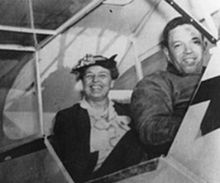
A. Philip Randolph's reputation as the most dangerous black man in America did not deter First Lady Eleanor Roosevelt from stepping in with whatever assistance her image could lend the civil rights issues. The First Lady even flew with a Tuskegee Airman to cement her support for the black pilots' program.

_______________


Tuskegee Airman Charles Alfred “Chief” Anderson and First Lady Eleanor Roosevelt
Tuskegee Airman
Charles Alfred Anderson
And First Lady Eleanor Roosevelt

First Lady Eleanor Roosevelt Airs Her Opinion


In the spring of 1941, with war raging in Europe and the likelihood that the United States would soon be drawn into the conflagration, Eleanor Roosevelt asked to be given an aerial tour of an airfield still under construction and in desperate need of funding. Assisted by the pilot, the First Lady climbed aboard the single engine, two-seater Piper Cub and off they soared.


That simple, spur-of-the-moment act shocked her Secret Service detail and others, not because of its inherent risk but because the pilot was black and the airfield was in Tuskegee, Alabama, deep in the segregated South.


Upon exiting the plane at the end of her 40-minute flight, Roosevelt confidently announced, “Well, he can fly alright!” 


Her endorsement, along with a widely distributed photograph (left) of the smiling First Lady and the celebrated African-American pilot, the late Charles Alfred “Chief” Anderson, garnered much attention for the newly established program to train black pilots at the Tuskegee Institute—just as the First Lady, an ardent supporter of civil rights, knew it would." (Reprinted from: New Jersey Monthly)


_______________


Daughters of the American Revolution (DAR) Denied Marian Anderson Use of Constitution Hall


DAR Constitution Hall, Washington DC
"Yet no amount of excellence or renown was sufficient to gain Marian Anderson—or any other black performer of that time—a booking at Washington, D.C.’s largest concert venue at the time, Constitution Hall, which is part of the national headquarters of the patriotic service organization, the Daughters of the American Revolution (D.A.R.). 

Throughout the 1930s, civil rights organizations, unions and performing arts groups tried to break down racial barriers in D.C. performing spaces; Constitution Hall was one of the larger targets. But when representatives from Howard University invited Anderson to D.C. to perform in 1939, a primarily local struggle became a major national controversy." (Reprinted from: Smithsonian Magazine)
_______________

Marian Anderson, One of the First Voices to Sing in the Soundtrack of the Civil Rights Movement


Constitution Hall had seemed a natural choice for Marian Anderson's concert, although her sponsors doubted that Daughters of the American Revolution would contract their facility to an African American, never having allowed non-whites to use the facility in the history of the venue.

Marian Anderson's concert was relocated to the Lincoln Memorial, a more fitting backdrop for her performance and the voice that became an integral voice in the soundtrack of the Civil Rights Movement, marking the beginning of the end of Jim Crow laws in America.

Marian Anderson Lincoln Memorial 1939


Marian Anderson (1897-1993)


Custom Search Anything Here!


Marian Anderson was a major musical and civil rights force in American culture and the international recording and music industry.


Marian Anderson, First Lady Eleanor Roosevelt  & Broadcaster, Edward R. Murrow
Marian Anderson, First Lady Eleanor Roosevelt
& Broadcaster, Edward R. Murrow

Between 1925 and 1965, Marian Anderson sang with major orchestras in the most famous musical venues in the United States and Europe. She was a recording artist in the early days of the modern music industry and was was offered parts in operas and stage productions in Europe. 

On January 7, 1955, the year I started first grade and the same year Rosa Parks started the Montgomery Bus Boycott, Marian Anderson became the first black person in the world to perform at New York's Metropolitan Opera. Thousands of black people worldwide rejoiced at this astonishing accomplishment in civil rights, including my mother and my music teacher, Mrs. King.

Marian Anderson's musical programs were primarily recitals and concerts comprised of opera arias, American Traditional music and American Spirituals derived from the sorrow of slaves and their lives on plantations in the American South before the Civil War and the Emancipation Proclamation.


Jim Crow Laws, promoted by President Woodrow Wilson, were partly to blame for civil rights infringements on Marion Anderson's right to perform at Constitution Hall. 


(courtesy Library of Congress, ca. 1918 )
Segregated Waiting Rooms U.S. Public Health Service Dispensary for Federal Workers, Washington D.C.

The real betrayal of President Woodrow Wilson was that he had led African Americans to believe he would support civil rights. Then after receiving their votes in his presidential campaign of 1912, he abandoned his promise and championed Jim Crow laws of the Deep South and in the nation's capitol.

_______________


President Woodrow Wilson Segregates Federal Employees


Woodrow Wilson, 28th U.S. President (1913-1921) segregated federal employees in Washington DC
President Woodrow Wilson
(1856-1924)
"Wilson permitted segregation in federal offices soon after becoming president, treating it, he said, not as an instrument of humiliation, but as a means to ease racial tensions. Dubois and like-minded thinkers disagreed heartily with Wilson's choice, petitioning repeatedly for the suspension of the practice. Wilson refused." 

(Reprinted from: The People's Experience, African Americans; Woodrow Wilson Presidential Library & Museum)
_______________


Woodrow Wilson, 28th U.S. President (1913-1921) segregated federal employees in Washington DC and in doing so had segregated the city itself and dealt a serious blow to civil rights. This legislation affected far more than federal employees. Legal segregation of Washington DC affected services, housing education and facilities, including performances at Constitution Hall, which would not allow the integrated audience Marian Anderson requested. With the nation's blessing, Jim Crow laws across the country were given sanction.

When I was growing up in the 1950s and 1960s, there were two separate United States of Americas, one black and one white. 


No Colored Allowed, May 25, 1925 Knoxville, Tennessee
No Colored Allowed, May 25, 1925
Knoxville, Tennessee
Like Marian Anderson, the America I lived in was the black one. When I learned the facts about Marian Anderson no being allowed to sing at Constitution Hall, I did not have to ask my mother why the DAR had refused to let her sing in their facility. Jim Crow protected the DAR decision to reject the singer's application. A world-renown concert performer--how dare she expect to be allowed to use that all-white facility! She was black! That was the way our nation operated when I was growing up. And that was that!

Hollywood Produced Segregated Movies 


The Wizard of Oz starring Judy Garland
Ten years before I was born, Hollywood released The Wizard of Oz, starring Judy Garland, epitomizing white American fantasy. 

The closest producers got to a colored cast member was Margaret Hamilton's portrayal of the Wicked Witch of the West and she was green

That was in 1939, the same year Marian Anderson's application to sing at Constitution Hall was tossed into the DAR trash can in its attempt to protect the same white America the Wizard of Oz portrayed.


Jim Crow Produced Segregated Movie Theaters


Given: Lincoln Theodore Monroe Andrew Perry
In Typical Role for African Americans
There was no place in The Wizard of Oz for an actor like Stepin Fetchit. However, my mother took me to see that and many other movies like it because movies with black casts were rare in our town and many "race movies" as they were called, were not acceptable to my mother's tastes portraying African Americans in a way which my mother did not approve--head-scratching, bugged-eyed, shiftless, lazy, frightened or menacing.

Ave Maria


I listened to Ave Maria by Marian Anderson and tried as hard as I could to mimic the recording, which, surprisingly, delighted Mrs. King. Ave Maria, however, was more challenging to my untrained nine-year-old voice. Near the end of the song, there were some very high notes that I was not sure how to approach. "Don't strain," coached Mrs. King, a classically trained vocalist and pianist. She then instructed me where to take my breaths between words, how much breath to inhale and how to use my diaphragm to control the strength of the release of notes and float the sounds on the air as I exhaled. 

The night stepped onto the stage for my performance, Mrs. King and I both knew I was no Marian Anderson and would never have that level of talent. But we also knew that without Marian Anderson's example, I would never have attempted to perform Ave MariaMy singing Marian Anderson was a milestone for me and my community because much of our popular music in those days was the Blues. I heard the Blues blaring and whining from beer joints everyday on my way home from school. And on Sundays, gospel poured into the streets from radios and churches up and down the block.

My mother was proud when I got a standing ovation for my performance. That was a proud moment for me, too. I thank my mother, Mrs. King and Marian Anderson for helping to prepare me for the changes that were on my horizon.