Marian Anderson became the voice of civil rights in 1939 when Jim Crow laws prevented her from singing at Constitution Hall.
 |
Marian Anderson, Lincoln Memorial 1939
The Voice
That Challenged a Nation
And its People
|
The voice that challenged a nation!
I was nine years old when my music teacher, Mrs Eloise King, sent me home with a Marian Anderson recording of Schubert's Ave Maria. She instructed me to practice the song for a performance as our school choir soloist.
"Just try your best to sing the song like Marian Anderson," Mrs. King told me. "Pay attention to your enunciation."
That was my first introduction to the music business. It was almost like being in the studio. I felt like a real professional musician standing in front of the microphone before a large audience of my peers and neighbors. red if that is how Marian Anderson felt when she performed.
I knew who Marian Anderson was; had read about her in one of my mother's books. My mother read everything and made me read, too. Anderson was the African American opera singer, who had sung Ave Maria on the steps of the Lincoln Memorial in Washington DC on April 9, 1939. The concert was arranged by First Lady, Eleanor Roosevelt, when the Daughters of the American Revolution (DAR) refused to allow Anderson to perform at Constitution Hall in Washington DC because she was "was not white," her manager Sol Hurok was told by facility administration.
Marian Anderson and other African Americans, like Rosa Parks, didn't like the way the United States of America treated us, but the choices were still few before Rosa Parks ignited the Montgomery Bus Boycott, which many believe was the beginning of the modern Civil Rights Movement, which launched Martin Luther King into the forefront of the movement as its leader against Jim Crows laws and legalized discrimination and segregation, which were nationwide and not just in the South.
However, on the eve of World War II (WWII), Marian Anderson and many others--A. Philip Randolph, among them, labeled the most dangerous black man in America--played a large role in fueling the Civil Rights Movement when she and then First Lady Eleanor Roosevelt put their heads together and arranged a performance at the Lincoln Memorial after Marian Anderson was snubbed by the DAR.
First Lady Eleanor Roosevelt continued her support for civil rights by going to President Franklin Roosevelt to propose racial equality in the United States. In such a move, the First Lady supported the efforts of A. Philip Randolph and others to promote the establishment of the Tuskegee Airmen, the first black pilots trained on U.S. soil. These pilots eventually fought air missions during WWII that helped to win the war.
Before that time, Jim Crow laws prohibited the training of black pilots in the United States. During this period of Jim Crow laws when the U.S. Military was still segregated, a Civil Rights Movement was taking shape right under the noses of those who opposed it most. The Tuskegee Airmen became known as Red Tails.
A. Philip Randolph's reputation as the most dangerous black man in America did not deter First Lady Eleanor Roosevelt from stepping in with whatever assistance her image could lend the civil rights issues. The First Lady even flew with a Tuskegee Airman to cement her support for the black pilots' program.
Woodrow Wilson, 28th U.S. President (1913-1921) segregated federal employees in Washington DC and in doing so had segregated the city itself and dealt a serious blow to civil rights. This legislation affected far more than federal employees. Legal segregation of Washington DC affected services, housing education and facilities, including performances at Constitution Hall, which would not allow the integrated audience Marian Anderson requested. With the nation's blessing, Jim Crow laws across the country were given sanction.
That was in 1939, the same year Marian Anderson's application to sing at Constitution Hall was tossed into the DAR trash can in its attempt to protect the same white America the Wizard of Oz portrayed.
I listened to Ave Maria by Marian Anderson and tried as hard as I could to mimic the recording, which, surprisingly, delighted Mrs. King. Ave Maria, however, was more challenging to my untrained nine-year-old voice. Near the end of the song, there were some very high notes that I was not sure how to approach. "Don't strain," coached Mrs. King, a classically trained vocalist and pianist. She then instructed me where to take my breaths between words, how much breath to inhale and how to use my diaphragm to control the strength of the release of notes and float the sounds on the air as I exhaled.
The night I stepped onto the stage for my performance, Mrs. King and I both knew I was no Marian Anderson and would never have that level of talent. But we also knew that without Marian Anderson's example, I would never have attempted to perform Ave Maria. My singing Marian Anderson was a milestone for me and my community because much of our popular music in those days was the Blues. I heard the Blues blaring and whining from beer joints everyday on my way home from school. And on Sundays, gospel poured into the streets from radios and churches up and down the block.
My mother was proud when I got a standing ovation for my performance. That was a proud moment for me, too. I thank my mother, Mrs. King and Marian Anderson for helping to prepare me for the changes that were on my horizon.
I knew who Marian Anderson was; had read about her in one of my mother's books. My mother read everything and made me read, too. Anderson was the African American opera singer, who had sung Ave Maria on the steps of the Lincoln Memorial in Washington DC on April 9, 1939. The concert was arranged by First Lady, Eleanor Roosevelt, when the Daughters of the American Revolution (DAR) refused to allow Anderson to perform at Constitution Hall in Washington DC because she was "was not white," her manager Sol Hurok was told by facility administration.
Marian Anderson sang for freedom against Jim Crow in 1939. Rosa Parks followed in 1955 sparking the Montgomery Bus Boycott.
 |
| Rosa Parks Montgomery Bus Boycott |
Marian Anderson was not just an important American singer, she was a U.S. civil rights leader in her own right before Rosa Parks ignited the Montgomery Bus Boycott.
First Lady Eleanor Roosevelt--Advocate for Civil Rights
 |
| Eleanor Roosevelt & Marian Anderson |
Not the first or last time First Lady Eleanor Roosevelt stepped forward to support civil rights
 |
| First Lady Eleanor Roosevelt And A. Philip Randolph, civil rights advocate for the Tuskegee Airmen Program |
Before that time, Jim Crow laws prohibited the training of black pilots in the United States. During this period of Jim Crow laws when the U.S. Military was still segregated, a Civil Rights Movement was taking shape right under the noses of those who opposed it most. The Tuskegee Airmen became known as Red Tails.
A. Philip Randolph's reputation as the most dangerous black man in America did not deter First Lady Eleanor Roosevelt from stepping in with whatever assistance her image could lend the civil rights issues. The First Lady even flew with a Tuskegee Airman to cement her support for the black pilots' program.
_______________
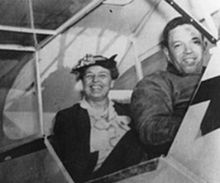 |
| Tuskegee Airman Charles Alfred Anderson And First Lady Eleanor Roosevelt |
First Lady Eleanor Roosevelt Airs Her Opinion
In the spring of 1941, with war raging in Europe and the likelihood that the United States would soon be drawn into the conflagration, Eleanor Roosevelt asked to be given an aerial tour of an airfield still under construction and in desperate need of funding. Assisted by the pilot, the First Lady climbed aboard the single engine, two-seater Piper Cub and off they soared.
That simple, spur-of-the-moment act shocked her Secret Service detail and others, not because of its inherent risk but because the pilot was black and the airfield was in Tuskegee, Alabama, deep in the segregated South.
Upon exiting the plane at the end of her 40-minute flight, Roosevelt confidently announced, “Well, he can fly alright!”
Her endorsement, along with a widely distributed photograph (left) of the smiling First Lady and the celebrated African-American pilot, the late Charles Alfred “Chief” Anderson, garnered much attention for the newly established program to train black pilots at the Tuskegee Institute—just as the First Lady, an ardent supporter of civil rights, knew it would." (Reprinted from: New Jersey Monthly)
_______________
Daughters of the American Revolution (DAR) Denied Marian Anderson Use of Constitution Hall
 |
| DAR Constitution Hall, Washington DC |
"Yet no amount of excellence or renown was sufficient to gain Marian Anderson—or any other black performer of that time—a booking at Washington, D.C.’s largest concert venue at the time, Constitution Hall, which is part of the national headquarters of the patriotic service organization, the Daughters of the American Revolution (D.A.R.).
Throughout the 1930s, civil rights organizations, unions and performing arts groups tried to break down racial barriers in D.C. performing spaces; Constitution Hall was one of the larger targets. But when representatives from Howard University invited Anderson to D.C. to perform in 1939, a primarily local struggle became a major national controversy." (Reprinted from: Smithsonian Magazine)
_______________
Marian Anderson, One of the First Voices to Sing in the Soundtrack of the Civil Rights Movement
Constitution Hall had seemed a natural choice for Marian Anderson's concert, although her sponsors doubted that Daughters of the American Revolution would contract their facility to an African American, never having allowed non-whites to use the facility in the history of the venue.
Marian Anderson's concert was relocated to the Lincoln Memorial, a more fitting backdrop for her performance and the voice that became an integral voice in the soundtrack of the Civil Rights Movement, marking the beginning of the end of Jim Crow laws in America.
Marian Anderson Lincoln Memorial 1939
Marian Anderson (1897-1993)
Custom Search Anything Here!
Marian Anderson was a major musical and civil rights force in American culture and the international recording and music industry.
 |
| Marian Anderson, First Lady Eleanor Roosevelt & Broadcaster, Edward R. Murrow |
Between 1925 and 1965, Marian Anderson sang with major orchestras in the most famous musical venues in the United States and Europe. She was a recording artist in the early days of the modern music industry and was was offered parts in operas and stage productions in Europe.
On January 7, 1955, the year I started first grade and the same year Rosa Parks started the Montgomery Bus Boycott, Marian Anderson became the first black person in the world to perform at New York's Metropolitan Opera. Thousands of black people worldwide rejoiced at this astonishing accomplishment in civil rights, including my mother and my music teacher, Mrs. King.
Marian Anderson's musical programs were primarily recitals and concerts comprised of opera arias, American Traditional music and American Spirituals derived from the sorrow of slaves and their lives on plantations in the American South before the Civil War and the Emancipation Proclamation.
Jim Crow Laws, promoted by President Woodrow Wilson, were partly to blame for civil rights infringements on Marion Anderson's right to perform at Constitution Hall.
 |
| (courtesy Library of Congress, ca. 1918 ) Segregated Waiting Rooms U.S. Public Health Service Dispensary for Federal Workers, Washington D.C. |
The real betrayal of President Woodrow Wilson was that he had led African Americans to believe he would support civil rights. Then after receiving their votes in his presidential campaign of 1912, he abandoned his promise and championed Jim Crow laws of the Deep South and in the nation's capitol.
_______________
President Woodrow Wilson Segregates Federal Employees
 |
| President Woodrow Wilson (1856-1924) |
"Wilson permitted segregation in federal offices soon after becoming president, treating it, he said, not as an instrument of humiliation, but as a means to ease racial tensions. Dubois and like-minded thinkers disagreed heartily with Wilson's choice, petitioning repeatedly for the suspension of the practice. Wilson refused."
(Reprinted from: The People's Experience, African Americans; Woodrow Wilson Presidential Library & Museum)
_______________
When I was growing up in the 1950s and 1960s, there were two separate United States of Americas, one black and one white.
 |
| No Colored Allowed, May 25, 1925 Knoxville, Tennessee |
Like Marian Anderson, the America I lived in was the black one. When I learned the facts about Marian Anderson no being allowed to sing at Constitution Hall, I did not have to ask my mother why the DAR had refused to let her sing in their facility. Jim Crow protected the DAR decision to reject the singer's application. A world-renown concert performer--how dare she expect to be allowed to use that all-white facility! She was black! That was the way our nation operated when I was growing up. And that was that!
Hollywood Produced Segregated Movies
 |
| The Wizard of Oz starring Judy Garland |
Ten years before I was born, Hollywood released The Wizard of Oz, starring Judy Garland, epitomizing white American fantasy.
The closest producers got to a colored cast member was Margaret Hamilton's portrayal of the Wicked Witch of the West and she was green.
That was in 1939, the same year Marian Anderson's application to sing at Constitution Hall was tossed into the DAR trash can in its attempt to protect the same white America the Wizard of Oz portrayed.
Jim Crow Produced Segregated Movie Theaters
 |
| Given: Lincoln Theodore Monroe Andrew Perry In Typical Role for African Americans |
There was no place in The Wizard of Oz for an actor like Stepin Fetchit. However, my mother took me to see that and many other movies like it because movies with black casts were rare in our town and many "race movies" as they were called, were not acceptable to my mother's tastes portraying African Americans in a way which my mother did not approve--head-scratching, bugged-eyed, shiftless, lazy, frightened or menacing.
Ave Maria
and tried as hard as I could to mimic the recording, which, surprisingly, delighted Mrs. King. Ave Maria, however, was more challenging to my untrained nine-year-old voice. Near the end of the song, there were some very high notes that I was not sure how to approach. "Don't strain," coached Mrs. King, a classically trained vocalist and pianist. She then instructed me where to take my breaths between words, how much breath to inhale and how to use my diaphragm to control the strength of the release of notes and float the sounds on the air as I exhaled. The night I stepped onto the stage for my performance, Mrs. King and I both knew I was no Marian Anderson and would never have that level of talent. But we also knew that without Marian Anderson's example, I would never have attempted to perform Ave Maria. My singing Marian Anderson was a milestone for me and my community because much of our popular music in those days was the Blues. I heard the Blues blaring and whining from beer joints everyday on my way home from school. And on Sundays, gospel poured into the streets from radios and churches up and down the block.
My mother was proud when I got a standing ovation for my performance. That was a proud moment for me, too. I thank my mother, Mrs. King and Marian Anderson for helping to prepare me for the changes that were on my horizon.