Translate


Showing posts with label American west. Show all posts

Thursday, February 6, 2014

A Chinese Immigrant Story: Voyage to America


One Chinese American Experience 


Before Fred took the boat from China nearly one hundred and fifty years ago, he had already learned things that people in Brazos County didn't know back then--like fancy fighting with his feet and hands that could break bones or even kill with one blow, and new ways to cook rice other than boiling it and burying it under chicken gravy.


Voyage To America: A Chinese Immigrant Story

When I was a little girl, a Chinese immigrant's grownup granddaughter, who was a neighbor, described her grandfather to me and showed me a picture of him while recalling details he'd meticulously told her about his life. 


Later, at home, in my personal journal, I wrote what she said and documented how the story made me feel as I was growing up during the Civil Rights Movement with my part-Comanche grandmother under Jim Crow laws. Although our heritage was different, I felt a certain kinship to the African American granddaughter of a Chinese immigrant grandfather. 

And years later, I included this article in my syndicated column and my memoir, Bigmama Didn’t Shop At Woolworth’s, about life with my part-Comanche grandmother during the Civil Rights Movement.

The American West was a mystery to me when I was a child until I met my neighbor. I had the impression that Chinese immigrants were only in California building railroads. That is certainly not the whole story as I was to learn. Even though I grew up on the historic boundaries of the American frontier, I had little idea that there had also been a Chinese American West, and it not been for Chinese immigrants and other immigrants as well, there may not have been an American West.

Chinese American Immigrant in the Mississippi Delta
I have kept notes from childhood throughout my adult life in personal journals, note books, slivers of paper, backs of used envelopes, napkins and even matchbooks. Personal journals have been an integral part of my writing career. In fact, I have taught journaling and published books of elementary school student writing and artwork, discovering a wealth of talent and imagination. I instruct them to write their observations and feelings as I did in my newspaper column and my book. You don't need a fancy journal, but it good to have a permanent place to keep notes, rather than have them scattered in desk drawers and shoe boxes. 

Today, of course, along with most everyone else who is a professional writer or not, I use laptops, net books and computer tablets, depending on where I happen to be. However, a simple old-fashioned paper journal or Big Chief Tablet will also do the trick, if you are really serious about keeping a journal. I have turned my notes into valuable chronicles of unknown historical treasures such as my article, African American, Native American and cowboy heritage, as well as the immigrant story: Voyage to America

In a very creative environment today, an electronic journal seems to be a must for most people. Personally, I use them all--computer tablets, net books, note books, laptops and personal audio recorders. I'm sure my mother, being an electronic gadget grabber that she was, would have sprung for one of these new electronic journals for herself, if not for me, although she might have let me use her tablet. My mother kept many different types of journals in regular note books, each labeled according to its content. Some were daily observations and ideas. Other journals, were devoted to her original songs and music compositions. Still others were drawings, art and recipes.


Because of my mother, we had television, automatic record changer and air conditioning before anyone else on our street, not because we were wealthy. We were not! During the era of Jim Crow laws, no one in our neighborhood had a high paying job. However, my mother's priorities included staying current with developing technology, which she read about in the books and periodical subscriptions.

Take down your memories, observations, thoughts and feelings in a journal and, remember, no one has to see it until you want to share your writing or not.


This memory and journal notes of the Chinese immigrant story remained an entry in my personal journal until I became a syndicated columnist many years later for Knight-Ridder and Hearst newspapers in the 1990s and was assigned columns recalling life in the 1950s and '60s before and during the Civil Rights Movement. As I grew as a columnist, journalist and writer, publishers and editors became interested in my published work and Bigmama Didn’t Shop At Woolworth’s (Texas A&M University Press) was born from a selection of my published collection of articles.`Young readers in Long Beach, California, middle schools read my stories, conducted lively discussions and made drawings to depict their interpretation of the stories' meanings and associated customs. Here is one of the articles, Voyage to America.


Tea Ceremony Set Chasen Whisk
Tea Ceremony Set
with Chasen Whisk #C3A509
I knew Fred well through stories I heard his granddaughter tell in the 1950s when I was a little girl. She said that her grandfather called himself Fred because the people in his new home could not seem to pronounce his old name. Once in America, Fred traveled to Texas when it was still the frontier, married a slave woman, and raised a brown-skinned family that would have gone unnoticed in our community if not for Fred's distinctive eyes. I knew people in Robertson County with eyes like Fred's, but their grandfather was from Japan. 

Kyoto Green Tea -  Sweet Green  Tea Financier  (French Butter Cake)  and Matcha Tea -
Kyoto Green Tea -
Sweet Green
Tea Financier
(French Butter Cake)
and Matcha Tea -
Fred's granddaughter's stories squeezed me under the ship's main floor and into dark, damp, flat quarters where the ceiling was too low to sit up.,Rocking and swaying from side to side, my imaginary ship made me queasy, while imaginary companions threw up on each other. Inside her stories, my own lungs labored as the air in the hole became thick with body odor and heavy with human excrement. I felt myself growing faint from the lack of something fresh to breath. 

Fred's granddaughter said the vessel ran short of food and drinking water. Before long, everyone who wasn't starving or dying of thirst was ill. Infections caused by unsanitary conditions, and by bites and stings from the ships animals and insects claimed the youngest first, then the elders. My knees weakened as I thought of that little Chinese boy watching the decayed bodies of his family being thrown over the side of a ship in the middle of the night. When he reached the shores of freedom, Fred was herded with hundreds of other into detention centers, concentration camps, plantations, factories and other similar places of servitude. When I heard my grandmother calling me home for dinner, I stood up feeling guilty for my own good fortune, and walked the short distance to the safety of a home filled with people who took care of me.


As I was writing my book, I realized the Chinese story was not too different from my own, except that our African ancestry was mixed with Comanche ancestry. 


The Chinese-American Immigrants in old west
The Chinese-American West
Read more about the Chinese on the American Western Frontier read: Exploring the Chinese-American West.That's the wonderful by product of writing--we learn how much we share and how similar we are as human beings.

This book, Chopsticks in the Land of Cotton: Lives of Mississippi Delta Chinese Grocers by John Jung, although not the same as my story of Chinese immigrants. 

Even if you do not have the desire to write a book, you may want to document your own ideas and feelings about life as you see it. I found that writing about my personal experiences gave me a great deal of hope and was gratifying in many unexpected ways. I have continued my writing experience in this blog: Sunny Nash - Race Relations in America.

Holidays Around the World:  Celebrate Chinese New Year:  With Fireworks,  Dragons, and Lanterns
Holidays Around the World:
Celebrate Chinese New Year:
With Fireworks,
Dragons, and Lanterns
Children have never had so many reasons to learn how Chinese people everywhere ring in the new and ring out the old. As China takes its new place on the global stage, understanding Chinese culture and values becomes ever more essential to our next generation. For two joyous weeks red is all around. The color represents luck and happiness. Children receive money wrapped in red paper, and friends and loved ones exchange poems written on red paper. The Chinese New Year is also an opportunity to remember ancestors, and to wish peace and happiness to friends and family. The holiday ends with the Festival of Lanterns, as many large communities stage the famous Dragon Dance. Fireworks, parades, lanterns, presents, and feasts: these are some of the joys experienced by all who observe Chinese New Year.

Celebrate Chinese New Year is the latest, timely addition to National Geographic’s popular Holidays Around the World series. With 25 colorful images and a simple, educational text, the book is a lively invitation to revel in this child-friendly, national and international holiday. Carolyn Otto brings the historical and cultural aspects of the Chinese New Year into focus, and young readers experience the full flavor of an event celebrated by over a billion people in China, and countless others worldwide. National Geographic supports K-12 educators with ELA Common Core Resources. 
Rosa Parks Jesse Jackson
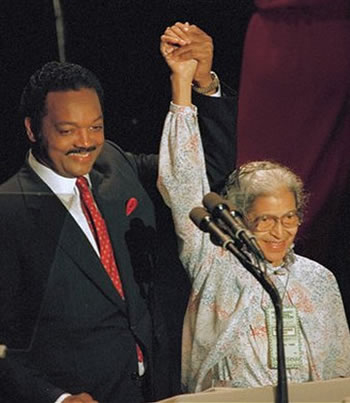
Jesse Jackson & Rosa Parks
I hope you will take a look at other posts in my blog likeRosa Parks: Black Womanhood, Rape & Lynching  about civil rights advocate and women's rights champion, Rosa McCauley Parks (February 4, 1913 – October 24, 2005) who helped all people, including the Chinese, to gain rights during the era of Jim Crow laws in the United States after the Montgomery Bus Boycott.  

Please go to the sidebar on the right to join my blog and be notified of new posts. Add your comments to the discussions to add information, opinions or suggest a related topic. All enlightenment is welcome. Share my posts with your friends and invite them to participate, too. Use the share buttons at the top of this post and the  LIKE button below.


Saturday, July 7, 2012

The Chinese-American West

One must explore immigration laws of California and other western American states to see full wonders of western territories--natural and racial colors.

Great Fountain Geyser. Great Fountain Geyser in Yellowstone
Great Fountain Geyser, Yellowstone National Park
Photo; National Geographic
When I was a little girl, my mother introduced me to the wonders of the American West. She had a sister who had moved to Denver and a brother who had moved to Northern California in the 1940s to avoid Jim Crow laws. 

My mother and I visited many Colorado, California and other western resorts, parks and reservations when I was young to witness in person the beauty of the land and people and to experience freedom we were denied at home. 

My early education formed a disturbing picture on our visits to beaches, mountains, indigenous people and immigrants.

Until my mother and I began to travel, I simply wondered about and accepted their facial features and listened to the stories of people in the neighborhood who knew the truth. Traveling and learning about Asian ethnic groups revealed a hidden history of the American West.

Most Americans do not realize the integral role Chinese immigrant laborers played in building Yosemite National Park. Many of these workers were former workmen on California railroad and levee systems that had been completed in the state. Below is a video that documents their participation in the building of the park. Chinese immigrants took this work after completing other projects in American development and then experiencing severe discrimination.

The film was researched, narrated and produced 
by Yosemite National Park Ranger Yenyen Chan 
for the National  Parks Service.

Creating the National Park Service: The Missing Years
In the 1870s through the early 1900s, Chinese were lynched in Colorado, Arizona, Oklahoma, California and other western states in an effort to rid the West of the race. Yellowstone National Park was established as the first park protected by the United States government in 1872. The same decade that the United States established its national park system, Chinatown in Denver was raided by a racist mob after hearing a rumor that a Chinese had killed a white man.

The World Rushed In: 
The California Gold Rush Experience
News of the discovery in 1849 in the foothills of northern California's Sierra Nevada Mountains traveled to all points around the world rapidly. The California Gold Rush attracted non-Native American gold diggers, pioneers and immigrants, including thousands of Chinese indentured servants in search of a new life crowded onto ships headed to California to take part in the claiming of the rich mineral claimsCompetition in the mining business was fierce among the untamed mod of gold diggers and murders, producing an atmosphere of violence and fear. Lynching of Chinese miners and other ethnic groups increased to discourage their participation and to steal their claims.

Interracial Encounters: 
Reciprocal Representations 
in African and Asian American 
Literatures, 1896-1937
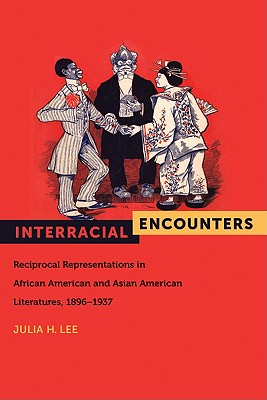
It was during our travels that I learned the deep cultural connections between African and Asian Americans that began during the 19th century. Interracial Encounters: Reciprocal Representations in African and Asian American Literatures, 1896-1937 explores literary relationships and similarities between the experiences of Asian and African characters during history.

Chinese immigrants in Hop Alley between Blake and Market Streets were beaten and lynched in an effort to rid the state of that race. The Rocky Mountain News (Denver) reported that homes were burned, businesses were looted and Chinese were killed by more than 3,000 anti-Chinese rioters, which reportedly included Irishmen, African Americans and other races, yelling “Stamp out the yellow plague.” The mob dragged a man named Look Young down 19th Street; according to a doctor, Young died “from compression of the brain, caused by being beaten and kicked.

Washington Historical Society
Tacoma, Washington, 1892

Racial tensions and Jim Crow legislation affecting Chinese and other groups were prevalent in many parts of the West as in the rest of the rest of the nation, in areas that one would not have expected to find racism and discrimination in housing, employment, education, public transportation, landownership and other aspects of daily life. The sign to the right was an announcement of a Tacoma, Washington, meeting concerning the expiration of the Chinese Exclusion Act of 1882  


Although beatings, murder and lynching on the Western Frontier did involve former slaves and their descendants, much of this violence was not limited to African Americans and Native Americans. Cases of lynching in the West occurred for the same reasons they happened in other parts of the nation.  Many cases of lynching and murder in the West occurred as a result of property rights, territorial disputes, employment, ethnic differences, religion and political competition. Immigrants were often targets. 

Mississippi Delta  Chinese Farm Family
Chinese Farm Family, Mississippi Delta

After being forced from gold mines during the California Gold Rush, Chinese immigrants became the primary source of labor for other industries, such as the construction of roads, highways, railroads, telegraph lines and other  American infrastructure in the West. In the 1850s, thousands of Chinese laborers built levee systems, roads and the intercontinental railway in California

When this dangerous work was done on these projects, where the death toll had been heavy, the Chinese laborers were scorned by the general population, prevented from getting an education in American schools and driven from their homes and businesses, which some had established in their segregated neighborhoods.

Burned out and chased away by racist mobs under the influence of Jim Crow laws, many Chinese immigrants in California were threatened, tortured and murdered as examples to others who later fled to other states or back to their homeland in China. 

The plight of the Chinese attracted Mississippi Delta plantation owners to California to exploit and import displaced Chinese farm families to Delta farms to replace slaves after Emancipation. Through labor agents, the same tactic was used to import southern Italian, Lebanese and Syrian indentured servants to Delta plantations to pick cotton alongside black workers who had stayed on farms after being freed.


Yosemite National Park
Yosemite National Park 
Photo: National Parks Service 

When word spread of the resources and beauty of the American West.


Naturalist, John Muir, campaigned to have the area protected. Yosemite National Park in northern California was created in 1890 with the U.S. Army in command from 1891 until 1914, when the United States entered World War I. 


The Immigration Act of 1924 further restricted Chinese and other Asian groups from entering the United States. The Chinese Exclusion Act was repealed in 1943, but Jim Crow laws against Chinese people continued to limit their freedom and civil rights. People in my own family and neighborhood had Chinese and Japanese ancestry mixed in with their African ancestry. 

Until my mother and I began to travel, I simply wondered about and accepted their facial features and listened to the stories of people in the neighborhood who knew the truth. Traveling and learning about Asian ethnic groups revealed a hidden history of the American West.


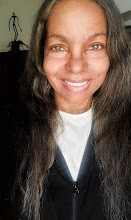
Sunny Nash
In my Book, Bigmama Didn't Shop At Woolworth's, recognized by the American Association of University Presses for contributing to the understanding of U.S. race relations, I write about this Chinese immigrant experience in a story called: Voyage to America. Follow the Link to read the entire story. Here is an excerpt from the essay.


Don't forget to leave me a comment below and please use the LIKE button.


Sunny Nash – Race Relations in America

Friday, April 8, 2011

Jim Crow in the African American West

The African American West: A Century of Short Stories spans Jim CrowTwentieth Century of black fiction.

  
Sunny Nash, Author
Sunny Nash, Author

My story, Amen, is in The African-American West: A Century of Short Stories co-edited by Bruce A. Glasrud, award-winning writer-editor and Professor Emeritus of History, California State University, East Bay, with Laurie Champion.


Experts are now calling me a western frontier writer, a title of which I am extremely proud, although I write most every style; writing is my career. What I try to capture in my portrayal of the Old West are the roles of African Americans and other ethnic groups in the development of the Old West.


In addition to Jim Crow laws, slavery, the Civil War, Reconstruction, civil rights, U.S. race relations and other pertinent subjects, my topics include diverse populations that are infrequently documentedThe African-American West (University Press, Colorado) proves that there is a great deal of interest in this area fiction writing, demonstrating numerous journalistic reports, historical accounts and personal reflections and memories in the form of short stories among the array of authors in this book, covering the 20th century on the Western Frontier. 

The African American West: A Century of Short Stories by Bruce Glasrud (University Press of Colorado 2000)
Bruce A. Glasrud, Editor


Laurie Champion, Editor
The African American West: A Century of Short Stories by Bruce Glasrud (University Press of Colorado 2000)

W.E.B. DuBois
W.E.B. DuBois/Jesus Christ in Texas


Ralph Ellison
Ralph Ellison/
Then confront World War II 
and aftermath: Mister Toussan 

Rita Dove, Poet Laureate
 Rita Dove/Damon and Vandalia
List of authors
Paul Laurence Dunbar 1876-1906
Colleen McElroy 1935 -
Eugene P. Frierson Unknown - 1946
Charles W. Chesnutt 1858 - 1932
Pauline E. Hopkins 1859 - 1930
W.E.B. DuBois 1868 - 1963
William Pickens 1881 - 1954
Anita Scott Coleman 1890 - 1960
Julian Elihu Bagley 1892 - 1981
Nick Aaron Ford 1904 - 1982
Arna Bontemps 1902 - 1973
March Lacy ? - ?
Langston Hughes 1902 - 1967
Margaret Williams ? - ?
Ralph Ellison 1904 - 1994
Frank Yerby 1916 - 1991
John Wesley Groves IV 1923 - 2009
Chester Himes 1909 - 1984
John O. Killens 1916 - 1987
Malvin Wald 1917 - 2008
John A. Williams 1925 -
Mike Thelwell 1939 -
Johnie Scott 1912 - 1976
John R. Posey 1944 -
Jack Burris ? - ?
Maxine Clair 1950 -
Eldridge Cleaver 1935 - 1968
Ed Bullins 1935 -
Ntozake Shange 1948 -
Joyce Carol Thoma 1938 -
Aya de Leon ? - ?
Terry McMillan 1951 -
Harryette Mullen 1953 -
Wanda Coleman 1946 - 2013
Charlotte Watson Sherman 1958 -
James Alan McPherson 1943 -
Jewell Parker Rhodes 1954 -
Cecil M. Brown 1907 - 1987
Percival Everett 1956 -
John Edgar Wideman 1941 -
William Henry Lewis 1968 - 1949
Carolyn Ferrell 1962 -
Reginald McKnight 1956 -
Walter Mosley 1952 -Sunny Nash 1949 - 


My story, Amen, like Christ in Texas by W.E.B. Dubois, is about a religious aspect of the African American West. My story is about a religious meeting, typical of those held in the community where I grew up in Texas, still considered at that time to be the Western Frontier (1950s). Amen's little girl witnesses a traveling preacher's dishonesty, similar to an experience I had with a cousin who took me to a revival meeting. I knew it wasn't exactly like going to church, being on a week night after work and school, and conducted in an abandoned rent house. Like me, the little girl in my story, didn't like church and would not have gone had she thought it was a real church. Sunday was enough!

When I think of my early church experiences, I was quite frightened by the congregation's response to a preacher yelling that we were all going to burn up in hell if we did or didn't do certain things. I couldn't understand most of what the preacher spat loudly between clinched teeth. So, I didn't know what I was supposed to do or not do. Everyone else seemed to understand what was expected, throwing hands in the air, getting happy and shouting, Amen! I sat glued to my seat afraid to open my mouth. To get happy in church or a religious meeting was a trance-like condition of individual members of the congregation when they seemed to experience an out-of-body state and be in intimate contact with the spirit. This state could last for a few minutes or longer with the person emerging from the trance with an improved  attitude or physical condition.

I am privileged to have been included in such great company as novelists, journalists, essayists, social activists, screen writers, historians, a Buffalo Soldier, Pulitzer Prize winners, a Poet Laureate, and other literary professionals. My story, Amen, was first published in Southwestern American Literature Journal (Texas State University Press), edited by Mark Busby. This story is now a chapter in a work of fiction I am completing. Read an excerpt from "Amenby Sunny Nash


Black Cowboys on the Old Western Frontier


Bigmama Didn’t Shop  At Woolworth’s  Sunny Nash
Hard Cover

Amazon Kindle
My grandmother, Bigmama, on whose philosophies I based my first book, Bigmama Didn't Shop At Woolworth's, was part Comanche and did not buy into some aspects of southern religious practices. Her father and all of his relatives were Black Indians that Bigmama referred to as prairie people. Bigmama had a Comanche name, which no one was allowed to say out loud. Her brother-in-law, Uncle George, called her by the name when he wanted to tease her. Bigmama didn't take teasing about her Comanche name very well, although Native American blood is common in families like ours. 

"There were Black Indians everywhere in this family," Bigmama said. "They were Comanche--full-bloods and half-bloods." Today, we have to think twice about what we call people, depending on the rules of political correctness. Bigmama did not care about political correctness then and would not care about political correctness now.


Black cowboys are also natural occurrences in our family today. In fact, some of the first cowboys on the Texas range were black cowboys, many of whom had been slaves or they had come into the territory for freedom before Texas was a slave state. 


Black Cowboy   
Sunny Nash's Uncle Tinney
Bigmama's Brother-in-law
Bigmama's brother-in-law, Uncle George, was a cowboy who broke wild Mustang horses on a ranch near Iola, Texas, where he lived until he died. He had to be pretty old when I knew him. Bigmama was born in 1890 and Uncle George was about her age. However, neither of them were born during slavery, but either or both of them could have had a slave or two in their ancestry. Another of Bigmama's brothers-in-law, Uncle Tinney, was also a cowboy, or at least he dressed like one. "Tinney's hands are too soft for a real cowboy," Bigmama said. "Tinney was more interested in making easy money selling moonshine. He really liked to dress."

A woman who spoke her mind in private, Bigmama would never let people know exactly what she thought. "If you are not careful, people will use what you think and feel against you," I heard her say many times. "Why would you give a person bullets to put in a gun to shoot you? No, some things are better left unsaid."

Bigmama Didn't Shop At Woolworth's
FaceBook Page
Bigmama detested how our neighborhood church allowed  dancing, shouting, screaming and the fainting off of certain church ladies into the waiting arms of handsome deacons. "I don't believe any of it is real," she said. Equally distasteful to her were the preachers, some of whom seemed more interested in how much money was on the collection plate or which sister was wearing the tightest outfit than how many souls they could save. She never went to revival meetings, which she compared to freak shows. My mother went to those performances to hear the gospel singing. It was never very good singing, though. My mother sang much better than traveling choirs in bad-fitting robes.

The child in my story is an observer who discovers the trickery of the preacher and her neighbor's participation in the perceived deceit of those in the congregation. Unlike me, having overheard conversations at home, the child in my story had no idea of the sham until she realizes that everyone knows about the trickery. These events were designed for the amusement and regular entertainment of isolated frontier communities. The traveling preachers went from one out-of-the-way town to another, recruiting volunteers like the neighbor in my story to play along with the act and get paid secretly. The acts included a volunteer pretending some illness or disability and then being miraculously cured by the phony preacher-healer in front a supposedly stunned audience. Then came the collection plate. Although few believed what they had just seen, they placed their hard-earned pennies into the plate as compensation for a good show. If the acting and the preacher's music were really good, then the plate would fill up. If not, then not so much money would be collected.


Google Custom Search


Lynching in the Early Twentieth Century American West


Lynching of Jesse Washington Waco, Texas, 1916
Lynching in Waco, Texas
Jesse Washington 1916
Although beatings, murder and lynching on the Western Frontier did involve former slaves and their descendants, much of this violence was not limited to African Americans and Native Americans. Cases of lynching in the West occurred for the same reasons they happened in other parts of the nation. Many of these cases of murder occurred as a result of property rights, territorial disputes, employment, ethnic differences and political competition. Immigrants were often targets. In fact, in California, during the Gold Rush when Chinese miners began attempting to purchase claims and enter the mines, lynching of Chinese miners increased to discourage the group from competing for the precious ore.

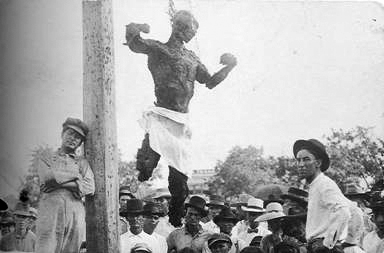
Glasrud and Champion included in The African American West DuBois' frontier story, Jesus Christ in Texas, about a Waco, Texas, black man accused of attacking a white woman and being lynched by a mob. The fictionalized lynching in DuBois' short story is reminiscent of the factual lynching of Jesse Washington. Charged with the rape and murder of a white woman, the 17-year-old farmhand, reported to be mentally retarded, was lynched in the frontier town of Waco, Texas, in 1916.

The lynching photograph was taken by a commercial photographer and published on a postcard showing the body of Washington who confessed to raping and killing a white woman, for which he was castrated, mutilated and burned alive by a cheering mob that reportedly included the mayor and police chief. An observer wrote that "Washington was beaten with shovels and bricks. . .[he] was castrated, and his ears were cut off. A tree supported the iron chain that lifted him above the fire. . . Wailing, the boy attempted to climb up the skillet hot chain. For this, the men cut off his fingers." On the back of the postcard was written: “This is the barbecue we had last night. My picture is to the left with a cross over it. Your son, Joe."


Black Women in the Modern American West


BREAKING THROUGH Lighting the Way Edited by Sunny Nash
BREAKING THROUGH Lighting the Way
Edited by Sunny Nash
Foreword by Carolyn Smith Watts

(l-r, rear) Evelyn Knight, Patricia Lofland
Bobbie Smith, Alta Cooke, Carrie Bryant
Vera Mulkey, Wilma Powell, Doris Topsy-Elvord
(seated l-r) Autrilla Scott, Maycie Herrington
Dale Clinton & Lillie Mae Wesley (not present) 
Racial tensions were prevalent in many parts of the West and the rest of the nation, in areas for may years after the frontier was officially closed. Although, one would not have expected to find racism and discrimination in housing, transportation, employment, education, public and other aspects of daily life.

A related article is Race Relations in America and Southern California, the story of black women who made a difference in the history of Southern California.


© 2014 Sunny Nash
All Rights Reserved Worldwide.

~Thank You~

Bookmark and Share Sunny Nash

Sunny Nash – Race Relations in America