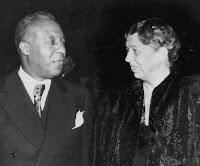
In 1948, Audrey Patterson became the first African American woman to win an Olympic medal.
 |
| Audrey Patterson & President Harry S. Truman The White House 1948 |
Audrey Patterson
Audrey Patterson was the first African American woman to win an Olympic medal--bronze--in 1948.
With all that gold being earned by African American women at the 2016 Summer Olympics in Rio, we should remember the first African American women to win Olympic medals, lest we forget that Audrey Patterson helped lay the groundwork for black female gold medalists in the 2016 Summer Olympic in Rio.
Audrey Patterson was born in 1926 in New Orleans, Louisiana, in the heart of Jim Crow America.
The Olympic Games were cancelled in 1940 and 1944 as many Americans were glued to the radio listening for developments of war with Germany. Audrey Patterson was in high school at the world was fighting in the European and Pacific theaters. No doubt, Patterson knew black soldiers in her family, her community or her school--although not allowed to enter combat in a meaningful way due to Jim Crow laws.
African American men nationwide were on the cusp of gaining important civil rights for themselves in the military, as well as for other American blacks back home.
During WWII, the Tuskegee Airmen, a unit of black pilots was organized at the instigation of black activist, A. Philip Randolph. The Army trained these men for air combat.Their proficiency proved so strong that they led to the desegregation of the U.S. Army by the Executive Order of President Harry S. Truman. After WWII ended in 1945, the next time a black American woman competed in the Olympics was in 1948. This was just before the official opening of the modern Civil Rights Movement when Rosa Parks and Martin Luther King burst onto the scene in Montgomery, Alabama, in 1954. In the meanwhile, black Americans were on the hunt for heroes to use in the fight against Jim Crow laws and the Olympics seemed as good a place as any. Female Olympians were training at both Tuskegee and Tennessee State in the tradition of former Olympic competitors.
Black females had been qualifying for the Olympics since 1932 in integrated track and field teams.
 |
1936 U.S. Female Olympic Track & Field |
Trained at Tuskegee Institute, Tydie Pickett and Louise Stokes entered competition with the 1932 Los Angeles Olympics and the 1936 Berlin Olympics teams. Both times, Pickett and Stokes were replaced at the last minute by white teammates they had previously defeated.These political decisions were made by Olympic officials and seemed to have something to do with race.
Audrey Patterson said she felt that 1936 Olympic gold medal winner, Jesse Owens, was speaking to her in 1944 when he told a group at Gilbert Academy, "There is a boy or a girl in this audience who will go to the Olympics."In 1947, Patterson enrolled at Wiley College in Marshall, Texas, where she became a track star, winning the Tuskegee Relays in the 100- and 220-yard dashes and the Amateur Athletic Union National Indoor Title in the 220-yard event. In 1948, Patterson transferred from Wiley to Tennessee State in Nashville, where she dominated the American record with another undefeated season. Patterson went to Providence, Rhode Island, for trials in the 1948 Olympics and earned a position on the U.S. Women's All-American Track & Field Team for the London Olympics. Patterson was one of the nine black females on the 12-member team.
At the time of the 1948 Olympics, Audrey Patterson, also known as Mickey, was a 22-year running beauty, who got cheers whenever the crowd caught a glimpse of her. And Mickey did not disappoint her international fans. By edging out Shirley Strickland of Australia, Patterson won a bronze medal for the 200-meter dash in the first Olympic Games that offered women the 200-meter race for competition. Fanny Blankers-Koen of the Netherlands won the race, her third gold medal. A few days later, African American track and field star from Tuskegee Institute, Alice Coachman, won a gold medal for the high jump.
When Audrey Patterson returned from the Olympics, her hometown newspaper, The Times-Picayune, did not mention her victory, which was interpreted by the black community as a snub because Patterson was an African American. The mayor did not attend her celebration ceremony, sending a certificate in his stead. However, President Harry Truman invited Patterson to the White House for a congratulatory visit after her history-making Olympic performance.
At the time of the 1948 Olympics, Audrey Patterson, also known as Mickey, was a 22-year running beauty, who got cheers whenever the crowd caught a glimpse of her. And Mickey did not disappoint her international fans. By edging out Shirley Strickland of Australia, Patterson won a bronze medal for the 200-meter dash in the first Olympic Games that offered women the 200-meter race for competition. Fanny Blankers-Koen of the Netherlands won the race, her third gold medal. A few days later, African American track and field star from Tuskegee Institute, Alice Coachman, won a gold medal for the high jump.
When Audrey Patterson returned from the Olympics, her hometown newspaper, The Times-Picayune, did not mention her victory, which was interpreted by the black community as a snub because Patterson was an African American. The mayor did not attend her celebration ceremony, sending a certificate in his stead. However, President Harry Truman invited Patterson to the White House for a congratulatory visit after her history-making Olympic performance.

In 1948, Rosa Parks had started her civil rights career with the Montgomery, Alabama, branch of the National Association for the Advancement of Colored People (NAACP) as a principal investigator in rape cases involving black Alabama women. Rape was a primary offense against black women during the era of Jim Crow laws, used to control activities and suppress esteem in the black community. It was during the next decade, that Rosa Parks and Dr. Martin Luther King led the Montgomery Bus Boycott that led to the dismantling of Jim Crow laws across America.
Although, during this same period changes were occurring nationally in race relations. The Tuskegee Airmen, a unit of black pilots had helped the United States win WWII and President Harry Truman had desegregated the U.S. Army. Both of these events were brought about by the encouragement of former First Lady Eleanor Roosevelt and black activist, A. Philip Randolph, labeled the most dangerous black man in America.
Although, during this same period changes were occurring nationally in race relations. The Tuskegee Airmen, a unit of black pilots had helped the United States win WWII and President Harry Truman had desegregated the U.S. Army. Both of these events were brought about by the encouragement of former First Lady Eleanor Roosevelt and black activist, A. Philip Randolph, labeled the most dangerous black man in America.
+of+48+u.s.+female+olympic+track+team.jpg) |
1948 U.S. Female Olympic Track & Field |
At the 1948 London Olympics, nine of the 12 members of the U.S. Women’s All-American Track & Field Team were African American. Audrey "Mickey" Patterson of Tennessee State became the first African American woman in Olympic history to win a medal.
Audrey Patterson was born in 1926 in New Orleans, Louisiana, in the heart of the Jim Crow south, steeping in discrimination against African Americans.
Audrey Patterson won a bronze medal for the 200-meter dash in the 1948 Olympics. That was the first time the 200-meter race was included in Olympic competition for female runners. In that 1948 Olympic Games, another African American female became the first black American woman to win a gold medal in Olympics history; Alice Coachman won the high jump and was inducted into eight athletic Halls of Fame. Later that year, the Amateur Athletic Union announced that Audrey Patterson had been named Woman Athlete of the Year.
________________________________________________
Thank you for visiting.
Please come again.
SUBSCRIBE & FOLLOW
 |
|
Hard Cover
Amazon Kindle
|
 |
Sunny Nash is an author, producer, photographer and leading writer on U.S. race relations.
Sunny Nash writes books, blogs, articles and reviews, and produces media and images on U.S. history and contemporary American topics, ranging from Jim Crow laws to social media networking. Sunny Nash is the author of Bigmama Didn't Shop At Woolworth's (Texas A&M University Press), about life with her part-Comanche grandmother during the Civil Rights Movement.
Sunny Nash’s book is recognized by the Association of American University Presses as essential for understanding U.S. race relations. Nash's book is also listed in the Bibliographic Guide for black studies at the Schomburg Center for Research in Black Culture in New York; and recommended for Native American collections by the Miami-Dade Public Library System in Florida. Nash uses her book to write articles and blogs on race relations in America through topics relating to her life--from music, film, early radio and television, entertainment, social media, Internet technology, publishing, journalism, sports, education, employment, the military, fashion, performing arts, literature, women's issues, adolescence and childhood, equal rights, social and political movements--past and present—to today's post-racism.
© 2015 Sunny Nash. All Rights Reserved Worldwide.
www.sunnynash.blogspot.com
~Thank You~